DAI GLOBAL, LLC
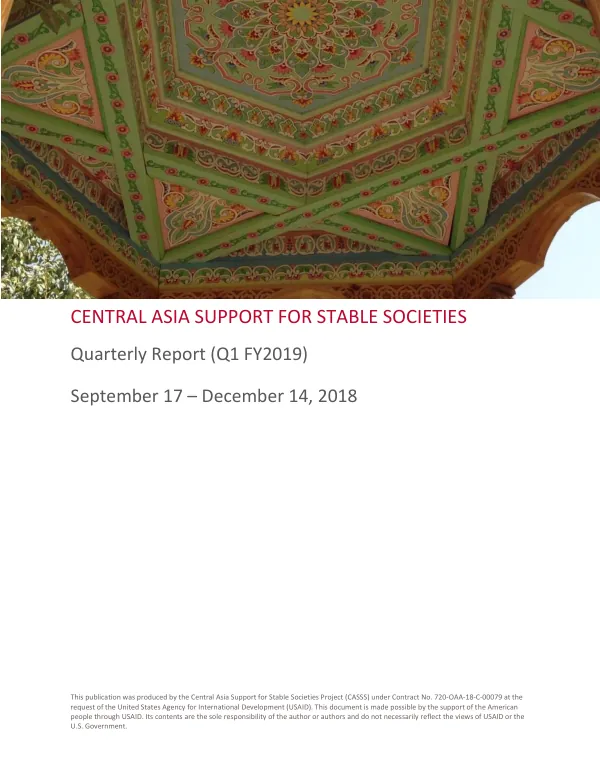
Quarterly Report (Q1 FY2019) for Central Asia Support for Stable Societies Project
The Central Asia Support for Stable Societies Project (CASSS) was awarded to DAI Global, LLC on September 17, 2018, following a Broad Agency Announcement (BAA) procurement process initiated by the United States Agency for International Development (USAID) in 2017.
2019 · 20 pages
Sign in to readA free account is required to download.
Abstract
The objectives of the program were to research, design, develop, test, pilot, generate new evidence, and validate existing theories about why people adopt violent extremist methodologies and/or provide support to violent extremist organizations. During the first quarter of CASSS implementation, the project made significant progress towards these objectives. The Chief of Party (COP) and Monitoring, Evaluation and Learning (MEL) & Research Director, accompanied by the project's USAID Contracting Officer's Representative (COR), visited the capital cities of each of the four countries of the award: Kazakhstan, the Kyrgyz Republic, Tajikistan, and Uzbekistan. Meetings were conducted to socialize and introduce the project with corresponding USAID and US Embassy personnel, host country governments, donors, implementing partners, and researchers working in the countering violent extremism (CVE) space. The country visits allowed the project to identify local research partners who will play key roles in the project's research. The CASSS team also established the conditions necessary to finalize the project's research design, which involved further defining the research environment in each of the four countries, identifying feasible research approaches and methodologies, identifying research partners, and deconflicting the project's proposed research with research being implemented by other international organizations or host governments. During this reporting period, the project submitted the first technical deliverable due under the contract, a desk study and literature review of previous research on violent extremism in Central Asia. The literature review explored existing sources that address the problem of extremism and radicalization in the four Central Asia countries of Kazakhstan, the Kyrgyz Republic, Tajikistan, and Uzbekistan. Based on a review of 72 different sources, the literature review summarized key findings on drivers of extremism regionally and in each country, and assessed methodologies employed to date to answer questions regarding radicalization and extremism risks. The project also submitted both the Grants Manual and Branding Strategy and Marking Plan pursuant to requirements in the contract. In relation to office set-up, USAID made the decision on November 6 that the main CASSS project office should be opened in Almaty, Kazakhstan. The DAI home office and project teams moved quickly to research and select an advantageous office location and began preparations to open additional CASSS offices in Bishkek, Tashkent, and Dushanbe. The project rapidly acted to recruit and advertise for the five CASSS Almaty office cooperating country nationals (CCN) positions, with post-interview position selections to be completed by December 20 (except for the Grants Manager who will be hired and commence duties in early 2019). DAI was also in constant working communication with the three designated project subcontractors: Swordfish Consulting International, Navanti Group, and SecDev Group, conducting negotiations on exact individual scopes of work and receiving necessary financial and other information necessary for compilations of consent to subcontract requests for submission to USAID. As of the date of this report's submission, USAID consent to subcontract has been received for Swordfish, with the subcontract between DAI and Swordfish fully executed. The request to subcontract was submitted to USAID for Navanti, with consent correspondingly pending. In relation to SecDev, scope of work determination and financial document compilation continue with completion expected during the early part of the second quarter. The CASSS project has made significant progress in its first quarter of implementation, establishing the conditions necessary to finalize the project's research design, identifying local research partners, and submitting key technical deliverables. The project has also made significant strides in office set-up, recruitment, and subcontracting, laying the groundwork for future success in countering violent extremism in Central Asia.