MCSP
Catalyzing Change: USAID & Maternal & Child Survival Program Year 1 Annual Summary
The Maternal & Child Survival Program was a multi-partner, flagship program in support of USAID's priority goal of ending preventable child and maternal deaths in a generation.
2015 · 2 pages
Sign in to readA free account is required to download.
Abstract
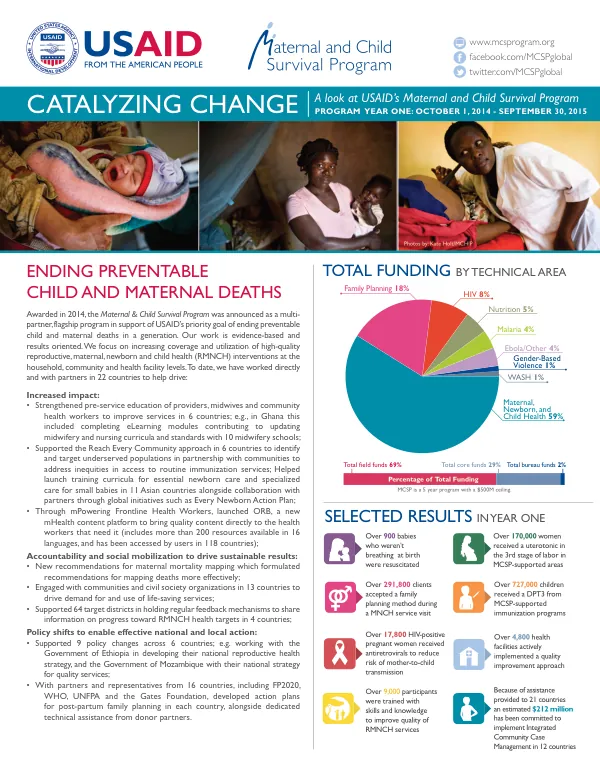
The program was launched in 2014 with a focus on increasing coverage and utilization of high-quality reproductive, maternal, newborn, and child health (RMNCH) interventions at the household, community, and health facility levels. The program worked directly and with partners in 22 countries to drive increased impact, accountability, and social mobilization to drive sustainable results. Strengthened pre-service education of providers, midwives, and community health workers was implemented in six countries, including Ghana, where eLearning modules were completed to update midwifery and nursing curricula and standards with 10 midwifery schools. The Reach Every Community approach was supported in six countries to identify and target underserved populations in partnership with communities to address inequities in access to routine immunization services. The program also launched training curricula for essential newborn care and specialized care for small babies in 11 Asian countries, alongside collaboration with partners through global initiatives such as the Every Newborn Action Plan. The mPowering Frontline Health Workers initiative was launched, which included the ORB, a new mHealth content platform to bring quality content directly to health workers that need it. The platform included more than 200 resources available in 16 languages and had been accessed by users in 118 countries. Accountability and social mobilization to drive sustainable results were also key components of the program. New recommendations for maternal mortality mapping were formulated, which provided recommendations for mapping deaths more effectively. Communities and civil society organizations in 13 countries were engaged to drive demand for and use of life-saving services. Additionally, 64 target districts in four countries held regular feedback mechanisms to share information on progress toward RMNCH health targets. Policy shifts to enable effective national and local action were also supported by the program. Nine policy changes were made across six countries, including working with the Government of Ethiopia to develop their national reproductive health strategy and the Government of Mozambique with their national strategy for quality services. Action plans for post-partum family planning were developed with partners and representatives from 16 countries, including FP2020, WHO, UNFPA, and the Gates Foundation. The program's first year, from October 1, 2014, to September 30, 2015, saw significant results. Over 900 babies who were not breathing at birth were resuscitated, and over 291,800 clients accepted a family planning method during a MNCH service visit. Additionally, over 4,800 health facilities actively implemented a quality improvement approach, and over 170,000 women received a uterotonic in the 3rd stage of labor in MCSP-supported areas. The program also supported the implementation of Integrated Community Case Management in 12 countries, with an estimated $212 million committed to this effort. The program's geographic focus included 22 countries, with a total of 24 MCH priority countries targeted. The program worked in 17 of these priority countries and in five others. The program's technical areas included maternal health, newborn health, child health, family planning, immunization, nutrition, malaria, WASH, and HIV. The program's goal was to introduce and support high-impact health interventions, with a focus on ending preventable child and maternal deaths within a generation.