USAID DEC
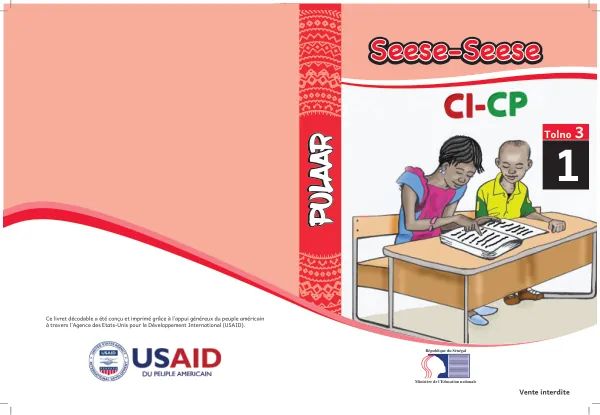
Ce livret décodable a été conçu et imprimé grâce à l’appui généreux du peuple américain à travers l’Agence des Etats-Unis pour le Développement International (USAID).
Sign inUSAID
Ce livret décodable a été conçu et imprimé grâce à l’appui généreux du peuple américain à travers l’Agence des Etats-Unis pour le Développement International (USAID).
The Pulaar language is spoken in several countries in West Africa, including Senegal, Guinea, and Guinea-Bissau.
2018 · 1 pages
Sign in to readA free account is required to download.
Abstract
In Senegal, it is the primary language spoken by the Wolof people. The language is part of the Senegambian branch of the Niger-Congo language family. Pulaar is a tonal language, with a complex system of tones that distinguish between different words. In Senegal, Pulaar is spoken by approximately 1.5 million people, primarily in the regions of Matam, Louga, and Saint-Louis. The language is also spoken in other countries, including Guinea, where it is spoken by around 1.2 million people. In Guinea-Bissau, Pulaar is spoken by around 200,000 people. The Pulaar language has a rich cultural heritage, with a strong oral tradition of storytelling and poetry. The language is also an important part of the region's history, with many historical events and traditions preserved through Pulaar language and literature. In recent years, efforts have been made to promote the Pulaar language and culture, including the development of language education programs and cultural programs. The Pulaar language is also an important part of the region's economic and social development. In Senegal, for example, the Pulaar language is used in business and commerce, particularly in the regions where it is spoken. The language is also used in education, with many schools and universities offering Pulaar language and culture courses. In terms of language documentation, the Pulaar language has been the subject of several studies and research projects. These studies have focused on various aspects of the language, including its grammar, vocabulary, and vocabulary usage, as well as its cultural and historical context. The language has also been the subject of several language education programs, aimed at promoting the use of Pulaar in education and in everyday life. The Pulaar language has a complex system of tones, with a total of 5 tones. The language also has a system of prefixes and suffixes that are used to indicate grammatical function and meaning. The language has a rich vocabulary, with a total of around 20,000 words. The language is also an important part of the region's cultural heritage, with many historical events and traditions preserved through Pulaar language and literature. In terms of language use, the Pulaar language is used in a variety of contexts, including in business and commerce, education, and education. The language is also used in everyday life, particularly in the regions where it is spoken. The language is also an important part of the region's cultural identity, with many people identifying as Pulaar speakers and using the language as a way to express their cultural heritage.
Related documents