USAID. MISSION TO PERU
CEDRU OPG - INTEGRATED DEVELOPMENT OF CAMPESINO COMMUNITIES
An Operational Program Grant is provided to the Center for Rural and Development Studies (CEDRU) to establish a pilot integrated rural development program for the rural poor in Carabaya, Peru.
1979
Sign in to readA free account is required to download.
Abstract
CEDRU will implement this project in the following campesino communities: Ajoyani, Huarachani, Ayusuma, Pacaje, Caracancha, Anansaya, Esquena, Uchuma, and Usicayos. A multi-purpose service center will be established to serve the project communities. A communal store in Ajoyani will sell household supplies and local products and will distribute products at wholesale prices to Pacaje, Huarachani, Anansaya, and Catacancha. It will also provide credit to its four community branches after these branches have established storage facilities and appointed their own administrations. A campesino administrative committee trained by CEDRU will manage the Anjoya store and CEDRU will develop an accounting system to be used by these members. A pharmacy in Ajoyani will be organized to market medicines to similar facilities in four nearby communities. Furthermore, medical posts in Pacaje and Huarachani will be built and medicines provided to service the entire system. A professional nurse will serve the area. A silo will be established in Ajoyana to provide agricultural inputs such as fertilizer and seed and to assist participants in marketing their agricultural products. Transportation costs will be partially covered. Improved seed will be offered on a loan basis and a seed fund will be set up to benefit the communities. Six community plots (charcas) established in Ajoyani, Coaza, and Macusani will be used to cultivate crops such as potatoes and quinoa. Communites will provide land and labor while CEDRU offers technical and administrative assistance. Two corrals with 80 Merino Precoz sheep and 80 alpacas will be set up in Coaza and Macusani. CEDRU will provide technical and veterinary assistance. Finally, short-term adult courses covering productivity and administration as well as social skills will be offered to 400 people. An economist will assist CEDRU and A.I.D. develop a system to evaluate the replicability of the project.
Related documents
Documents in this collection
 1981
1981USAID DEC
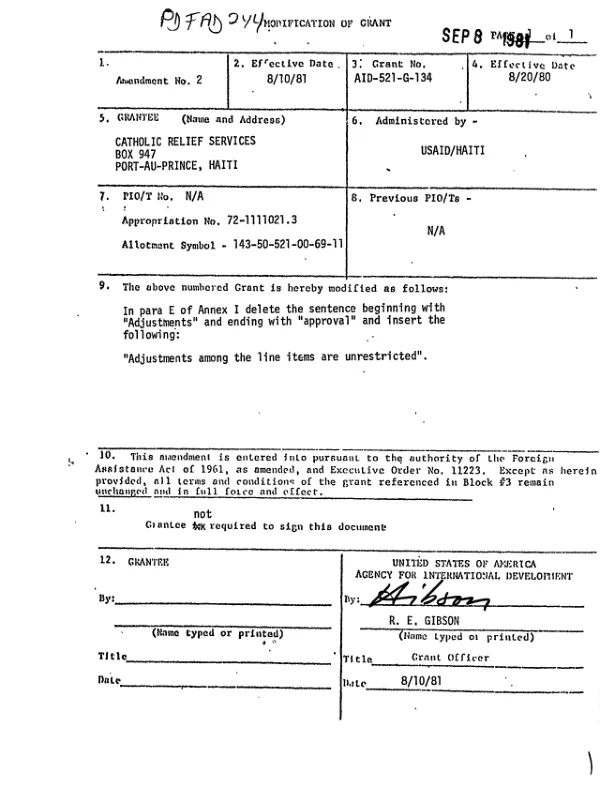
AID grant no. AID-521-G-134 amendment no. 2 to Catholic Relief Services for the groupement pilot project which will develop and test a methodology for peasant organization and non-formal education in rural Haiti
Open record1986
USAID DEC