THE INTERNATIONAL FOUNDATION FOR ELECTORAL SYSTEMS
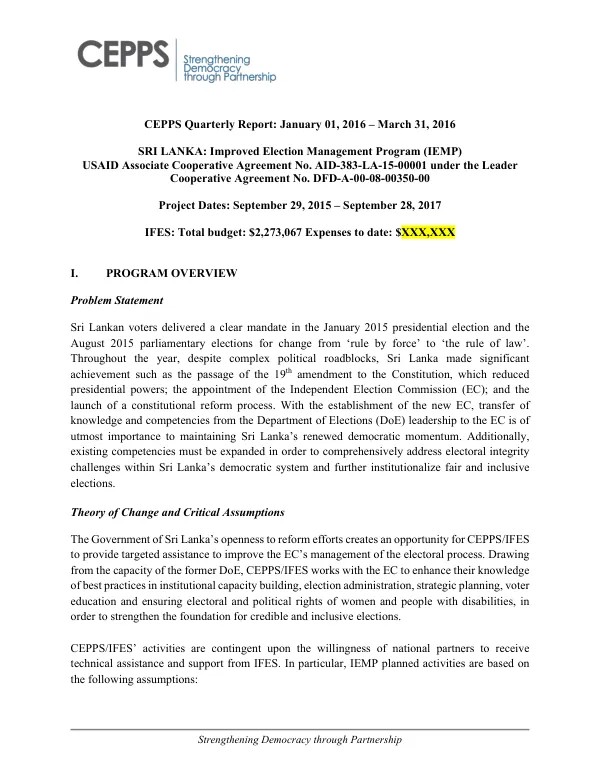
CEPPS Quarterly Report: January 01, 2016 – March 31, 2016
The Improved Election Management Program (IEMP) in Sri Lanka aimed to strengthen the country's election management body, the Independent Election Commission (EC), in its transition to an independent public commission.
2016 · 20 pages
Sign in to readA free account is required to download.
Abstract
The program, implemented by CEPPS/IFES, received funding from USAID under the Leader Cooperative Agreement No. DFD-A-00-08-00350-00. The project dates spanned from September 29, 2015, to September 28, 2017, with a total budget of $2,273,067. The program's objectives were to assist the Sri Lankan election management body in its transition to an independent election commission, build the EMB's institutional capacity to administer credible and inclusive elections, and improve the content and efficacy of voter education programs. CEPPS/IFES worked with the EC to enhance their knowledge of best practices in institutional capacity building, election administration, strategic planning, voter education, and ensuring electoral and political rights of women and people with disabilities. The program's activities were contingent upon the willingness of national partners to receive technical assistance and support from IFES. Key assumptions included the EC's willingness to engage with CEPPS/IFES, the acceptance of international experts provided by CEPPS/IFES, and the receptivity of the EC to input from civil society and other electoral stakeholders. Throughout the quarter, the Public Representations Committee (PRC) on Constitutional Reforms held public hearings, completing the hearing process on March 15. The PRC sought inputs from across Sri Lanka in an island-wide exercise that included public sittings, verbal submissions over the phone, and solicitations through social media. The timing of local elections continued to be a point of contention, with some officials stating that the ongoing issues related to boundary delimitation would preclude the possibility of local elections prior to 2017. The delay of local elections has also impacted the internal politics of the Sri Lanka Freedom Party (SLFP) and the possible formation of a new Joint Opposition in Parliament. A group of approximately 50 Members of Parliament (MPs), mostly consisting of SLFP members loyal to former President Mahinda Rajapaksa, had earlier suggested that they would form a new political party, and it was believed that local elections would provide an incentive to form this political party to demonstrate popular support at the polls. CEPPS/IFES completed its draft Electoral Integrity Assessment (EIA) and met with key electoral stakeholders, including Election Commission members and staff, and representatives from election observer groups and civil society organizations. The meetings enabled CEPPS/IFES to provide an overview of the EIA's objectives, findings, and recommendations and receive feedback to contribute to finalizing the report. Findings also contributed to a CEPPS/IFES presentation at Transparency International Sri Lanka (TISL) on campaign and political finance regulations. CEPPS/IFES provided technical support to electoral reform activities, including engaging civil society advocates in national-level dialogues on constitutional submissions that promote the political participation of women and persons with disabilities. CEPPS/IFES also conducted BRIDGE trainings on Electoral Administration and Gender.