USAID DEC
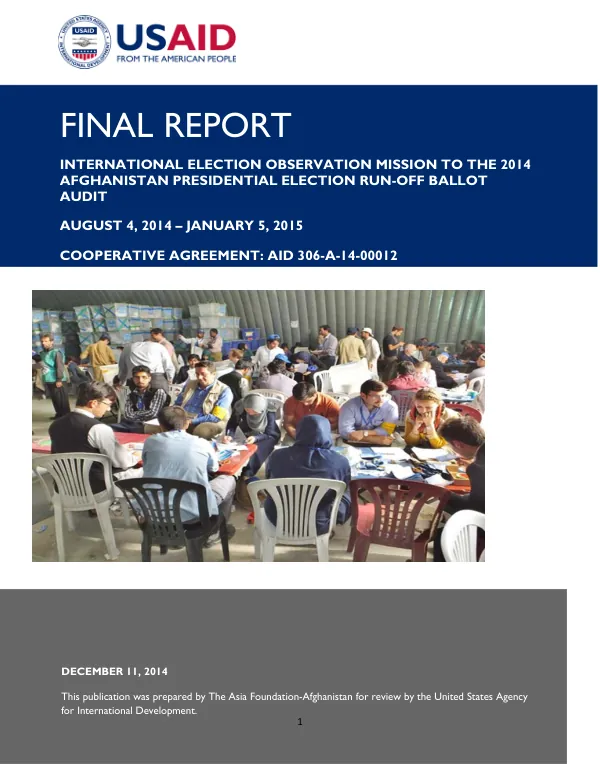
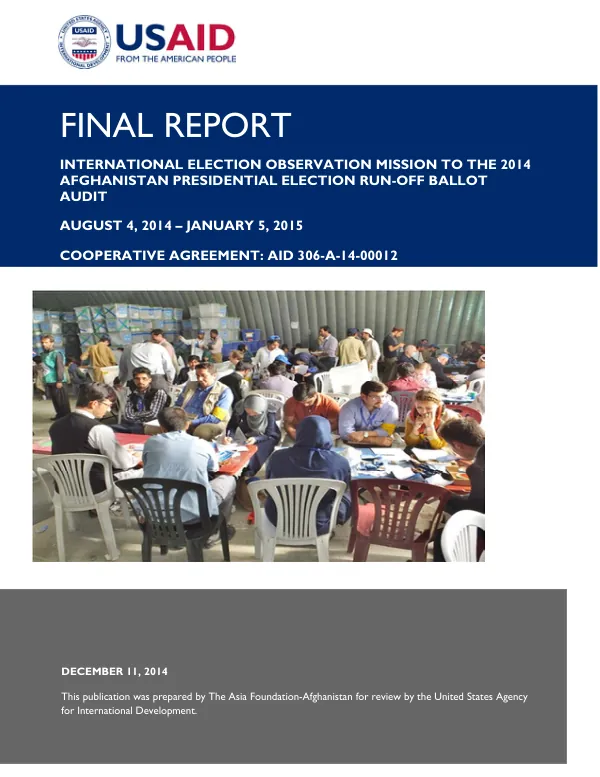
Final Report: International Election Observation Mission to the 2014 Afghanistan Presidential Election Run-off Ballot Audit
Sign inTHE ASIA FOUNDATION
Final Report: International Election Observation Mission to the 2014 Afghanistan Presidential Election Run-off Ballot Audit
The 2014 Presidential election cycle in Afghanistan was an important milestone in the country's post-Taliban period and an opportunity to effectuate the first democratic transition of power from one administration to the next.
2014 · 38 pages
Sign in to readA free account is required to download.
Abstract
The first round of voting was held on April 5, 2014, with none of the candidates receiving the 50 percent plus one vote needed to win. As a result, the two leading Presidential candidates, Abdullah Abdullah and Ashraf Ghani, faced off in a second round of voting on June 14, 2014. Following the release of initial results from this second round, candidate Abdullah Abdullah alleged massive fraud in favor of his opponent Ashraf Ghani. Both Presidential candidates requested a full investigation of the serious and credible allegations of fraud and called for measures to separate fraudulent ballots from valid votes. An audit plan, facilitated by the United States Secretary of State, John Kerry, and implemented through the United Nations Assistance Mission in Afghanistan (UNAMA), was agreed to by the two Presidential candidates on July 12, 2014. The plan, founded upon international best practice, called for a complete audit of the 8,109,493 ballots cast in the runoff election of June 14, 2014. The Asia Foundation International Election Observation Mission operated as one of four US Government-sponsored international observer missions to the audit. The audit team, comprising 28 international observers and analysts, including 12 women, represented a dozen countries. The team was led by Mission Director Andy Campbell, with Lead Observers Hugh Fulton and Bill Clay providing support. The audit process was facilitated by the Independent Election Commission for Afghanistan (IEC) and the Independent Electoral Complaints Commission (IECC), with security provided by the International Security Assistance Force (ISAF) and the Afghan National Security Forces (ANSF). The audit plan was implemented over a period of five months, from August 4, 2014, to January 5, 2015. The audit team conducted a thorough examination of the ballots, using a combination of manual and electronic methods to verify the accuracy of the results. The team also observed the audit process, providing feedback and recommendations to the IEC and IECC. The audit results showed that the initial results of the second round of voting were largely accurate, with some minor discrepancies. However, the audit also identified several instances of fraud and irregularities, which were addressed through the audit process. The audit team's findings and recommendations were presented to the IEC and IECC, with the aim of improving the conduct of future elections in Afghanistan. The Asia Foundation's International Election Observation Mission played a critical role in the audit process, providing technical assistance and support to the IEC and IECC. The mission's findings and recommendations were also presented to the US Government and other international stakeholders, highlighting the importance of a transparent and accountable electoral process in Afghanistan. The audit process was a significant milestone in Afghanistan's democratic transition, demonstrating the country's commitment to a free and fair electoral process. The Asia Foundation's International Election Observation Mission was proud to have played a part in this process, and looks forward to continuing its support for democratic development in Afghanistan.
Related documents