MANAGEMENT SCIENCES FOR HEALTH
Challenge TB–South Sudan Year 1 Quarterly Monitoring Report April – June 2015
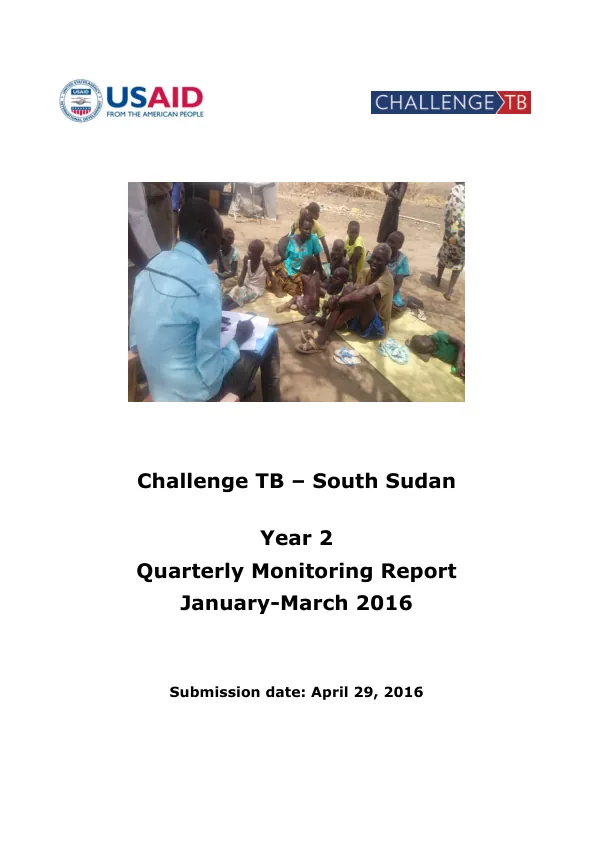
The Challenge TB-South Sudan program began in October 2014 with funding from the Global Fund and USAID TB core funds.
2015 · 18 pages
Sign in to readA free account is required to download.
Abstract
The program aimed to strengthen the national TB response in South Sudan, particularly in complex emergency settings. The lead partner for the program was Management Sciences for Health (MSH), with other partners including the South Korean Foundation (KOFIA) and the South Sudan National TB Program (NTP). The program's workplan for the first year (October 2014 to September 2015) focused on several key objectives, including enabling an environment for effective TB response, improving access to quality TB diagnosis and treatment, and ensuring the availability of rapid diagnostics for priority populations. The program also aimed to finalize a TB strategy for the emergency TB response in South Sudan. During the reporting period (April to June 2015), the program made significant progress in several areas. In the internally displaced camps, 16 clinicians/nurses were trained on TB case management, 5 laboratory technicians were trained on sputum smear microscopy, and 20 community health workers were trained on basics of TB, identification, and referral of presumptive TB cases. A total of 92 suspects were sent for sputum smear microscopy, with 22 (24%) being smear positive. In the Juba Protection of Civilian (POC) site, 36 patients were sent for sputum smear microscopy, with 8 (22%) being smear positive. The program also supported the quarterly review meetings for TB community mobilizers in Yei and Morobo Counties, which were attended by 35 participants. The meetings reviewed community mobilizer's activities, reported achievements and challenges, and drew an action plan for future activities. The program also conducted 93 health education sessions, sensitized 13,091 people on TB, and referred 318 suspects for sputum smear microscopy. In terms of rapid diagnostics, the program established the use of X-pert machines in diagnosing MTB/RIF in Juba, with two machines available at the Central Reference Laboratory (CRL). Training on the use of the Xpert algorithm was conducted for 24 clinicians/nurses and laboratory staff from health facilities within Juba City. A total of 44 samples were transported to the Xpert site, with 17 (39%) being Mycobacteria TB (MTB) positive, including 4 (24%) that were Rifampicin resistant (RIF). Despite the progress made, the program faced several technical and administrative challenges, including the on-going political crisis, which has resulted in an increase in insecurity and affected the implementation of activities. The local currency has also depreciated against the dollar, making it difficult to purchase commodities and supplies. To address these challenges, the program has developed an accelerated implementation plan, which includes hiring new technical staff and seeking a waiver to pay for goods and services in dollars. The program's Year 1 activity progress report highlights several key milestones, including the finalization of the TB strategy for the emergency TB response, the development of a community TB workers manual, and the update of the TB training manual. However, some of these milestones have not been met due to delays in the submission of the first draft of the TB strategy and the stakeholder meeting for the community TB workers manual.