USAID DEC
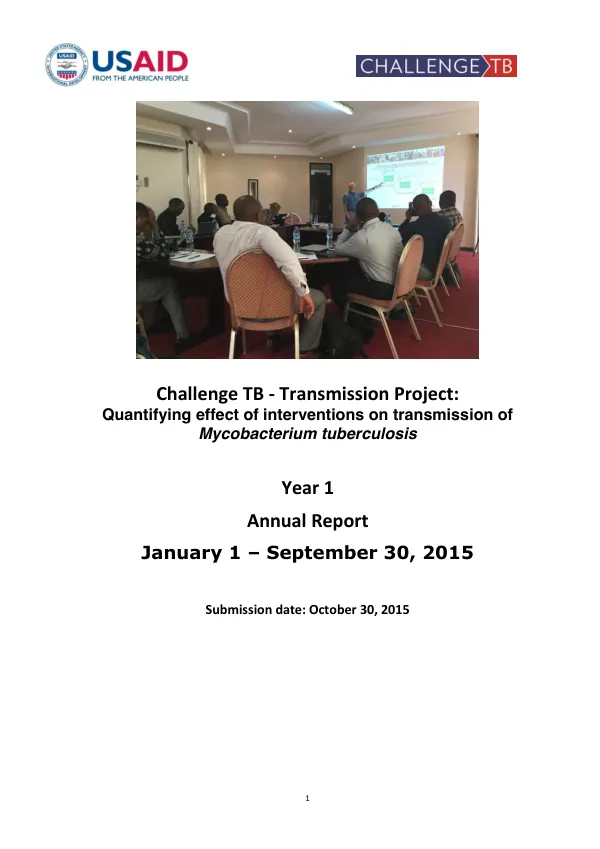
Challenge TB - Transmission Project: Quantifying effect of interventions on transmission of Mycobacterium tuberculosis
Sign inKNCV TUBERCULOSIS FOUNDATION
Challenge TB - Transmission Project: Quantifying effect of interventions on transmission of Mycobacterium tuberculosis
The Challenge TB - Transmission Project aims to evaluate the impact of United States Agency for International Development (USAID)-supported interventions on the transmission of Mycobacterium tuberculosis (M.
2015 · 10 pages
Sign in to readA free account is required to download.
Abstract
tb). The project's overall objective is to assess the effectiveness of these interventions in specific facilities, among high-risk populations, and in communities at large. The secondary objective is to map transmission patterns of TB and multi-drug resistant TB (MDR-TB). The project is led by the American Thoracic Society (ATS) and KNCV Tuberculosis Foundation (KNCV), with USAID as the primary funder. A steering committee has been established, comprising USAID, KNCV, ATS, and other experts. The committee has developed a charter and a Scientific Advisory Group of Experts (SAGE) to provide guidance on the project's implementation. Initial activities included an expert consultation meeting in Washington DC, which advised on priorities, site selection criteria, and study designs. A work plan development workshop was held at KNCV, where it was agreed to start with Indonesia and Tanzania. Site assessments were conducted in both countries, and local research partners were identified. In Tanzania, a sub-agreement was proposed with the National Institute for Medical Research (NIMR), and three sub-studies were proposed: reducing transmission in the community, decentralizing treatment initiation of MDR-TB patients, and screening miners for active tuberculosis. However, due to changes in the Challenge TB regions, the initial site in Tanzania was replaced with a new location in the Kilimanjaro region. In Indonesia, the National TB Operational Research Group (TORG) welcomed the project, and a risk map was defined based on site criteria and laboratory capabilities. A competitive bidding process was agreed upon for local subcontracting. The project also aims to expand to other countries, including Zimbabwe, the Democratic Republic of the Congo (DRC), Nigeria, and Kyrgyzstan. A smaller protocol was developed for MDR-TB transmission in the DRC, which may also be applied to other countries. Site assessment information was collected and shared with USAID for discussion with Country Missions. In year 2, the project expects to start data collection in Tanzania and Indonesia and conduct scoping missions and protocol development in three other countries. The project's ultimate goal is to provide recommendations for future USAID investments and develop targeted interventions to reduce the transmission of M. tb. The project's scientific rationale is based on the need to assess the impact of prevention and care interventions on reducing transmission of M. tb. USAID intends to examine the effect of project interventions on transmission of M. tb at national or subnational levels. To achieve this, the project will use a combination of quantitative and qualitative methods, including genotyping, community-wide TB intervention studies, and TB infection control. The project's methodology will involve the collection of data on TB transmission patterns, including the use of genotyping and other molecular techniques. The project will also conduct site assessments and develop protocols for local subcontracting. The project's findings will provide recommendations for future USAID investments and inform the development of targeted interventions to reduce the transmission of M. tb. The project's geographic focus is on Tanzania, Indonesia, and other countries, including Zimbabwe, the DRC, Nigeria, and Kyrgyzstan. The project's timeframes are year 1 (January 1 - September 30, 2015) and year 2, with expected start of data collection in Tanzania and Indonesia and scoping missions and protocol development in three other countries. The project's recommendations will be based on the findings of the project's evaluation and will provide guidance on the development of targeted interventions to reduce the transmission of M. tb. The project's ultimate goal is to contribute to the control and elimination of TB and MDR-TB in the countries involved.
Related documents