USAID DEC
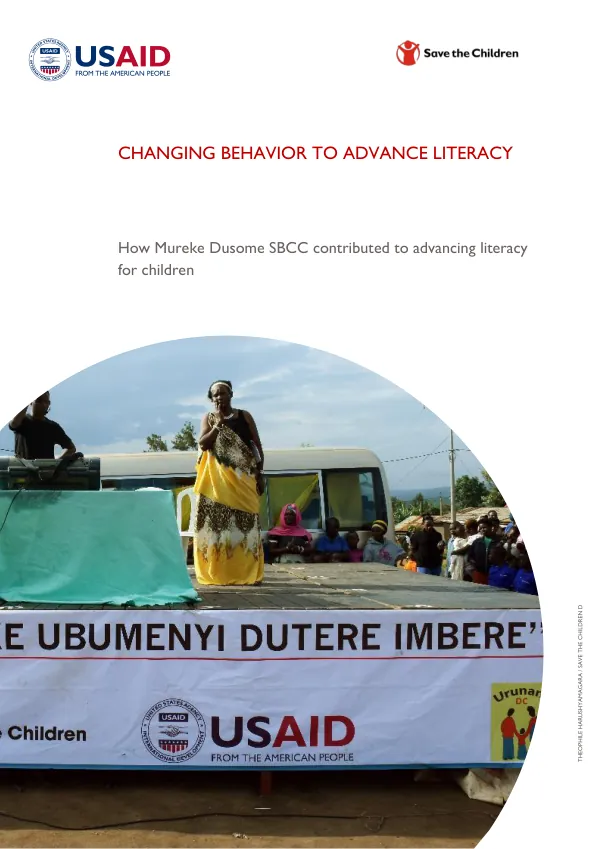
Changing Behavior to Advance Literacy: How Mureke Dusome SBCC Contributed to Advancing Literacy for Children
Sign inSAVE THE CHILDREN FUND
Changing Behavior to Advance Literacy: How Mureke Dusome SBCC Contributed to Advancing Literacy for Children
The Mureke Dusome Social Behavior Change Communication (SBCC) strategy aimed to popularize and promote a culture of reading in Rwanda by creating an environment in which parents, communities, local leaders, civil society actors, government, and businesses are supportive of reading among children.
2021 · 27 pages
Sign in to readA free account is required to download.
Abstract
The strategy drew from the Rwanda Media Barometers published by the Rwanda Governance Board in 2017 and 2018, which listed radio, community meetings, and mobile phones as the most widely used channels to obtain information by Rwandans. The SBCC strategy addressed the challenges identified by the Mureke Dusome baseline survey on knowledge, attitudes, and practices (KAP) related to school-community partnerships for literacy. The KAP survey explored positive and negative predictors among children, parents, and School General Assembly Committees (SGACs). Positive predictors included having Kinyarwanda storybooks at home and having time to read at home and in the community. The survey also identified factors that were perceived to prevent parents from supporting their children's literacy, including lack of time, illiteracy, and ignorance. The SBCC campaign aimed to expose children from P1 to P3 to positive literacy messages in an effort to improve their knowledge, attitudes, and practices related to reading between 2016 and 2021. The messages intended to change KAP for parents and communities to engender more support for children's reading practices. This would lead children to improve their reading abilities by spending time reading and practicing reading skills in their homes and communities through regular participation in community reading activities such as Umuganda Literacy, reading clubs, and reading festivals. The target groups for Mureke Dusome messages were parents, caregivers, children, Head Teachers (HTs), teachers, School General Assembly Committees, and local leaders. The messages were designed to respond to barriers preventing children from participating in reading activities at home and in the community, and parents from supporting their children in reading at home and in the community. Mureke Dusome developed a multipronged approach to reach the varied target groups, including a media campaign using radio, TV, print, and online media; ICT-4D: SMS/IVR & Social Media; literacy campaigns; literacy events; coordination through existing structures; and policy dialogue for systems strengthening. The media campaign involved training select media houses to ensure their buy-in and awareness of literacy issues, and encouraging them to continue communicating key Mureke Dusome literacy messages through community radio broadcasts, newspaper articles, and TV programs. Radio was used as the main channel for mass communication to disseminate literacy messages in the Mureke Dusome SBCC approach. Targeted 15-minute radio programs were used to disseminate literacy messages, supplemented by broadcast and print news. Public Service Announcements (PSAs) were produced and aired at Rwanda Broadcasting Agency to disseminate literacy messages targeting parents, children, teachers, and local leaders. A total of 24 PSAs were produced and disseminated during the life of the project. The Urunana soap opera series was also used to disseminate literacy messages. A total of 185 Urunana episodes containing Mureke Dusome's literacy messages were produced and broadcast on Radio Rwanda and Radio Ten. Mureke Dusome attended Urunana DC workshops to ensure proper incorporation of literacy messages into the series, and attended Urunana DC's quarterly script meetings to review the content of previously aired episodes and discuss the quality, flow, and messaging for the upcoming episodes. Audience surveys and feedback collection tools were designed to evaluate the effectiveness of the SBCC approach. The surveys and tools were used to collect data on the knowledge, attitudes, and practices of the target groups, and to identify areas for improvement. The data collected was used to inform the development of new messages and materials, and to evaluate the impact of the SBCC approach on literacy rates in Rwanda.