USAID DEC
Changing the paradigm - using metrics to define strategy and critical paths in public health supply chain transformation
Sign inSCMS
Changing the paradigm - using metrics to define strategy and critical paths in public health supply chain transformation
Public health supply chain transformation requires a paradigm shift in management practices.
2014 · 1 pages
Sign in to readA free account is required to download.
Abstract
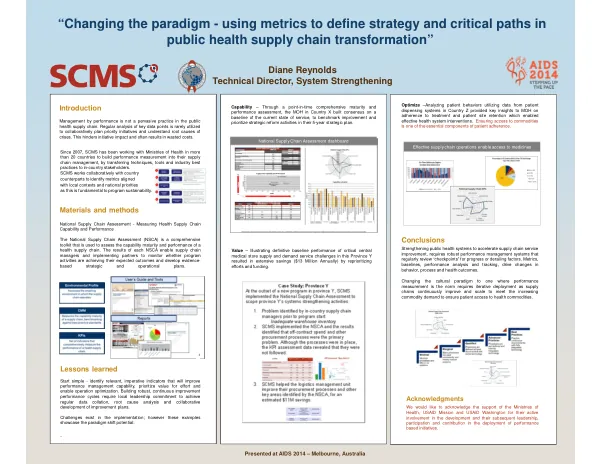
Metrics play a crucial role in defining strategy and critical paths in this transformation. The National Supply Chain Assessment (NSCA) is a comprehensive toolkit used to assess the capability maturity and performance of a health supply chain. The results enable supply chain managers and implementing partners to monitor program activities and develop evidence-based strategic and operational plans. Management by performance is not a widespread practice in the public health supply chain. Regular analysis of key data points is rarely utilized to collaboratively plan priority initiatives and understand root causes of crises. This hinders initiative impact and often results in wasted costs. To address this, supply chain managers should start by identifying relevant, imperative indicators that will improve performance management capability. Prioritizing value for effort and enabling operation optimization are essential for building robust, continuous improvement performance cycles. Local leadership commitment is critical to achieving regular data collation, root cause analysis, and collaborative development of improvement plans. Challenges exist in the implementation of performance-based initiatives, but examples showcase the paradigm shift potential. In one particular outcome, a figure explores the results of a complicated table, demonstrating the effectiveness of performance measurement in driving changes in behavior, process, and health outcomes. Strengthening public health systems to accelerate supply chain service improvement requires robust performance management systems that regularly review "checkpoints" for progress or derailing factors. Metrics, baselines, performance analysis, and tracking drive changes in behavior, process, and health outcomes. Changing the cultural paradigm to one where performance measurement is the norm requires iterative deployment as supply chains continuously improve and scale to meet increasing commodity demand to ensure patient access to health commodities. Value can be illustrated through definitive baseline performance of critical central medical store supply and demand service challenges. For example, in Province Y, reprioritizing efforts and funding resulted in extensive savings of $13 million annually. Optimizing patient behaviors utilizing data from patient dispensing systems in Country Z provided key insights to the Ministry of Health on adherence to treatment and patient site retention, enabling effective health system interventions. Ensuring access to commodities is one of the essential components of patient adherence.
Related documents
Documents in this collection
 2021
2021USAID DEC
Food, Energy, Water Baseline Assessment for Solomon Islands Strengthening Competitiveness, Agriculture, Livelihoods and Environment (SCALE) Architecture and Engineering Support
Open record 2021
2021USAID DEC