USAID DEC
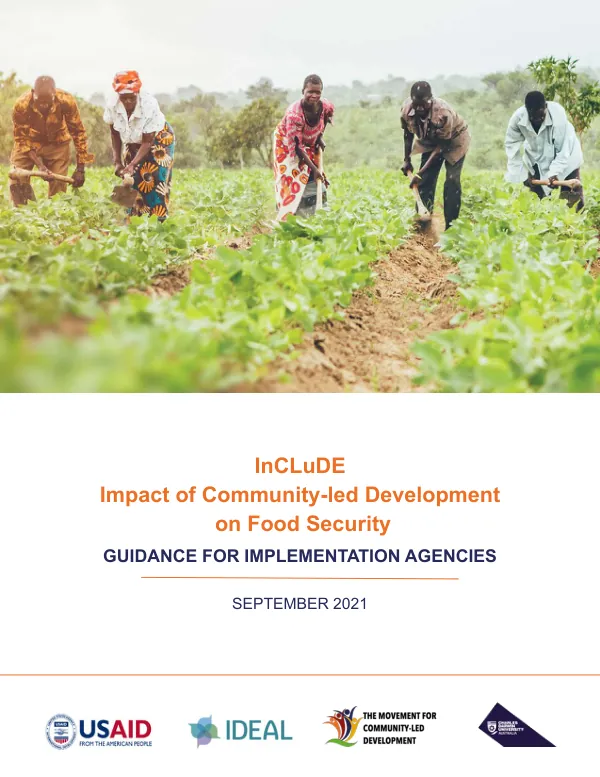
InCLuDE: Impact of Community-led Development on Food Security, Guidance for Implementation Agencies
Sign inUSAID
InCLuDE: Impact of Community-led Development on Food Security, Guidance for Implementation Agencies
Community-led development (CLD) is increasingly recognized as a pathway to support communities towards resilience and sustainability of desirable development outcomes.
2021 · 24 pages
Sign in to readA free account is required to download.
Abstract
Advocates argue that CLD leads to effective and efficient program implementation, enhances sustainability, facilitates poverty reduction at scale, increases social capital, and strengthens governance. However, there is relatively little understanding of the current practice of CLD, including what works, where, why, and how. A collaborative research project undertaken by the Movement for Community Led Development (MCLD) and Charles Darwin University aimed to understand the current practice of CLD and its impacts. The research program consisted of two phases: the first phase produced a CLD Assessment Tool and a Quality Appraisal Tool for CLD Evaluations, while the second phase involved a rapid realist review examining how CLD contributes to equity and resilience in relation to food security. The review included 117 documents, 93 of which were sourced from MCLD member organizations and 24 from the USAID Development Experience Clearinghouse. The findings from the review are presented below, along with implications and recommendations. Key Finding 1: Context Matters - Environments enable or limit CLD. The review found that the effectiveness of CLD depends on the context in which it is implemented. Environments that support CLD, such as those with strong community engagement and social capital, are more likely to lead to successful outcomes. Key Finding 2: Many current activities fall short of CLD practice. The review found that many current activities and programs do not fully embody the principles of CLD, such as community leadership and facilitation. This can lead to ineffective and unsustainable outcomes. Key Finding 3: Facilitation and leadership need explicit attention and resourcing. The review found that facilitation and leadership are critical components of CLD, but often receive inadequate attention and resourcing. This can lead to a lack of community engagement and ownership. Key Finding 4: Program design and implementation are central to CLD. The review found that the design and implementation of CLD programs are critical to their success. Programs that are well-designed and implemented are more likely to lead to effective and sustainable outcomes. Key Finding 5: Five forms of capital are necessary for CLD for food security. The review found that five forms of capital - social, human, physical, financial, and natural capital - are necessary for CLD to achieve food security outcomes. Key Finding 6: CLD needs a greater focus on equity. The review found that CLD programs often neglect issues of equity, such as unequal access to resources and opportunities. This can lead to unequal outcomes and perpetuate existing inequalities. Key Finding 7: CLD can contribute to resilience by building various kinds of capital. The review found that CLD can contribute to resilience by building different forms of capital, such as social and human capital. Key Finding 8: Multi-sectoral approaches can contribute to food security outcomes. The review found that multi-sectoral approaches, which involve collaboration between different sectors and stakeholders, can contribute to food security outcomes. Key Finding 9: Formalised structures support CLD. The review found that formalised structures, such as community organizations and networks, can support CLD and enhance its effectiveness. Key Finding 10: Structured advocacy processes can increase communities' power. The review found that structured advocacy processes, which involve community members in decision-making and planning, can increase communities' power and influence. Key Finding 11: Clear terminology and program theory are required. The review found that clear terminology and program theory are necessary to ensure that CLD programs are well-designed and implemented. Key Finding 12: Stronger evaluation and reporting could strengthen CLD. The review found that stronger evaluation and reporting practices could enhance the effectiveness of CLD programs and improve their sustainability. These findings have implications for the design, implementation, and evaluation of CLD programs. They suggest that CLD programs should be designed and implemented in a way that takes into account the context in which they are operating, and that facilitation and leadership are critical components of CLD. They also suggest that CLD programs should prioritize equity and focus on building different forms of capital.