USAID. BUR. FOR SCIENCE AND TECHNOLOGY. OFC. OF HEALTH
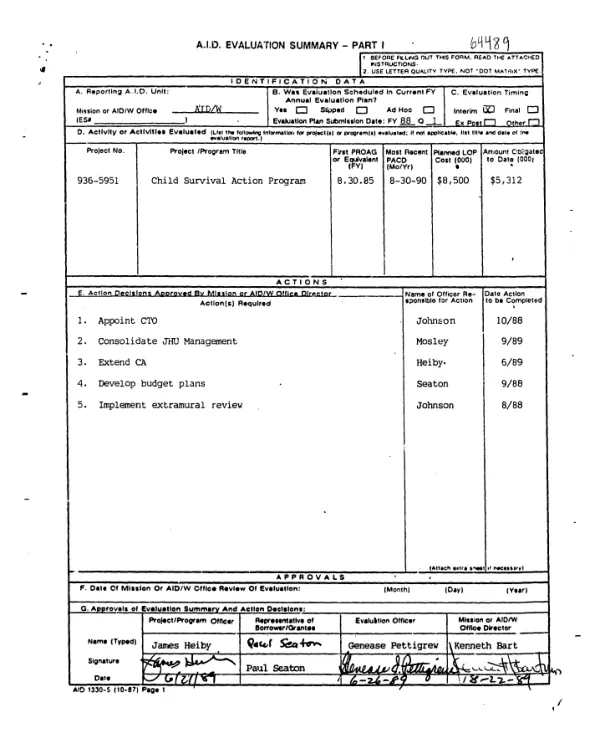
Child survival action program
Summarizes mid-term evaluation (XD-ABA-386-A) of a project implemented by Johns Hopkins University"s Institute for International Programs (JHU/IIP) to improve the availability and effectiveness of child survival technologies and activities in developing countries.
1989
Sign in to readA free account is required to download.
Abstract
Evaluation covered the period 8/85 to 6/89. Overall, the project has been successful. The evaluation, immunization, and vitamin A working groups have technical merit, are relevant and useful to A.I.D."s priorities, and have produced several excellent studies; Vitamin A activities have particular merit and should be given priority in the future. The Child Survival Fellows Program, which provides long-term overseas opportunities for health professionals, is proving imaginative and has the potential to make a major contribution in the development of a new cadre of qualified international health professionals. Moreover, the project has been the chief factor in establishing the IIP in JHU"s School of Hygiene and Public Health (SHPH); and it has prompted several top SHPH professionals and graduate students to focus their research efforts on child survival. However, there are problems which have hindered project effectiveness. IIP has not adequately disseminated research findings and related information to the academic community and to international health professionals and agencies. At the administrative level, the SHPH is implementing the project as if it were the first phase of a long-term institutional support activity rather than as a finite project limited by time and money. Additionally, the project design contains a set of activities which extend beyond the capacity of the budget. While annual work plans were intended to prioritize and refine these objectives and the budgetary implications, this has not yet occurred. Finally, project management at IIP and S&T/H has been weak, the major reasons for which are the following. (1) The project circumvented more traditional program development due to a congressional earmark. (2) S&T/H"s overall program and management workload often stretches or exceeds available professional and support staff capacity. (3) IIP, as a newly created organization with an evolving mission, has new leadership and adminstrative capacity. (4) In IIP"s university environment professional and academic interests may occasionally outweigh management concerns.
Related documents