USAID DEC
Intervention of oral rehydration therapy and vitamin A in two kabupaten in Central Java
Sign inUSAID. BUR. FOR FOOD FOR PEACE AND VOLUNTARY ASSISTANCE. OFC. OF PRIVATE AND VOLUNTARY COOPERATION (PVC)
Intervention of oral rehydration therapy and vitamin A in two kabupaten in Central Java
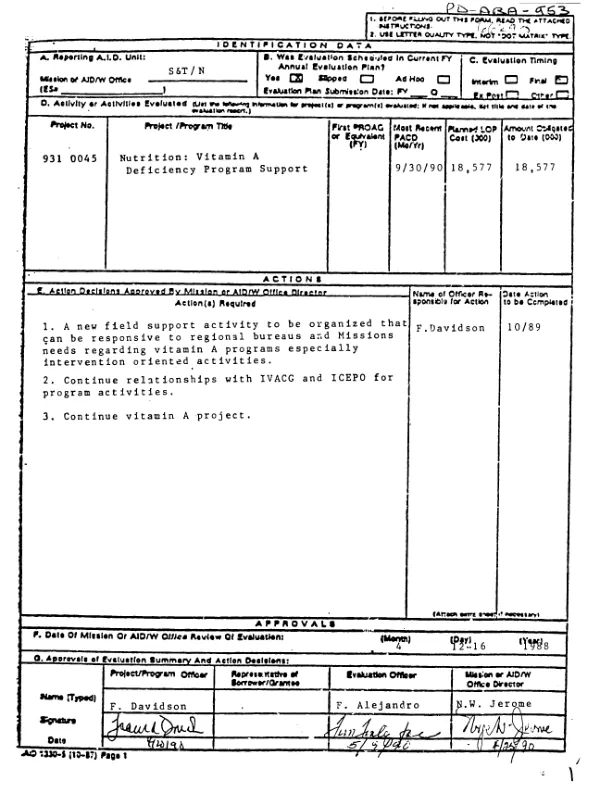
Summarizes mid-term external evaluation of the Rovita Project, a Vitamin A/oral rehydration therapy (ORT) project being implemented at two pilot sites in Central Java, Indonesia, by Helen Keller International (HKI), with funding from projects 9380284 and 9310045.
1990
Sign in to readA free account is required to download.
Abstract
The evaluation period is not specified. The Rovita Project has used a social marketing approach to promote (1) mothers" use of ORT for diarrhea in their young children, and (2) dietary supplementation with high-dose (200,000 IU) Vitamin A capsules for children aged 1-5. After initial delays, progress has been steady. The project team has: (1) conducted market research to determine target audience and media; (2) trained 5,000 health trainers and volunteers in diarrhea management and capsule distribution and produced related training materials; (3) developed and disseminated booklets, banners, and radio spots for the two target interventions; and (4) promoted the sale of oral rehydration salts (ORS) in villages by training retailers in diarrhea management and by giving each trained retailer a promotional stock of 50 ORS packets. The project is also conducting a double-blind assessment of the effects of high-dose vitamin A on child morbidity, particularly diarrheal morbidity, as well as conducting assessments of the delivery system for ORT and vitamin A and of the project"s impact on mothers" knowledge, attitudes, and practices. Although the project involves a complicated set of organizations and activities, the cooperative efforts of the staff have enabled the project to increase Vitamin A distribution rates from a baseline figure of 60% to 75% of targeted children. The original goal of 90% coverage has proved unrealistic. Despite the project"s success, the evaluators recommended that ORT and Vitamin A programs be administered separately in the future. HKI disagrees with this recommendation, and suggests that integrated efforts may have greater institutional impacts than do separate projects. HKI also suggests that the actual vitamin A coverage rate (i.e., the ingestion rather than the distribution rate) is probably lower than the 75% figure. The KAP survey should supply some answers in this regard. Several lessons were learned. (1) The political climate for Vitamin A activities is unusually favorable in Indonesia. (2) Choice of pilot sites in Central Java where the village health volunteer system is relatively strong could hinder replicability in areas where the volunteer system is weak.
Related documents
![Child Health Institute (CHI) and International Child Care (ICC) : final evaluation of the child health project -- ICC/CAT-PSC, Zone III -- area of Nippes [Haiti]](https://covers.devme.ai/gen/6069.webp)