JOINT UNITED NATIONS PROGRAMME ON HIV/AIDS , GENEVA
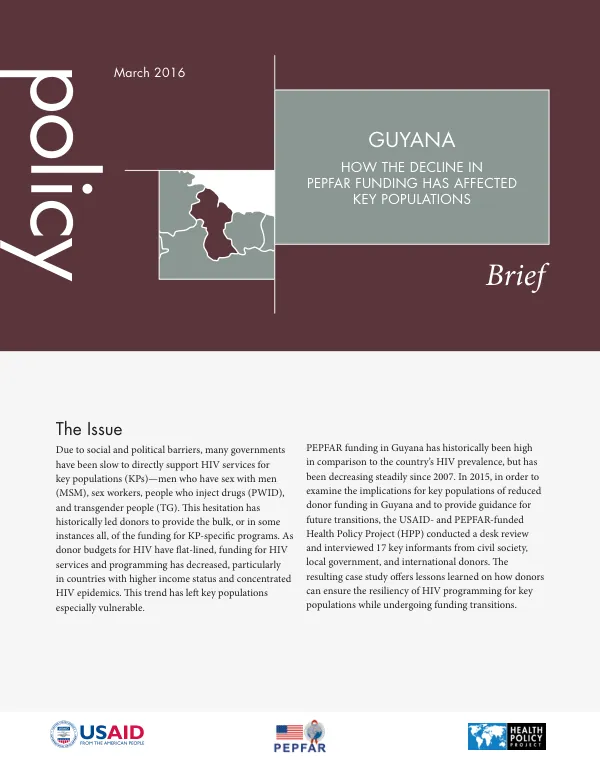
GUYANA: How The Decline In PEPFAR Funding Has Affected Key Populations
The country of Guyana is a small, lower-middle income nation situated on South America's northern coast.
2016 · 8 pages
Sign in to readA free account is required to download.
Abstract
With a population of approximately 763,900, Guyana has a relatively low national HIV prevalence of 1.4% among adults aged 15-49. However, AIDS remains one of the leading causes of death in the country. The majority of Guyana's 7,700 people living with HIV (PLHIV) reside in Region Four, which is home to 42% of the country's population and its capital city. HIV prevalence is notably higher among key populations, including female sex workers (FSW), men who have sex with men (MSM), and transgender people (TG). FSW and MSM have HIV prevalence rates of approximately 5% and 4.9%, respectively, while TG individuals have a prevalence rate of over 8%. Injection drug use is relatively uncommon in Guyana, although there have been no HIV prevalence studies among people who inject drugs (PWID). The legal and social context in Guyana poses significant challenges for key populations. Sex work, same-sex relations, and drug use are heavily stigmatized, and sex work is effectively criminalized due to prohibitions against brothels. Key population-focused organizations report routine harassment by police, and same-sex relations are prohibited under ill-defined legal statutes. The country's laws also criminalize cross-dressing, although the provision was recently invalidated by the Supreme Court. The Government of Guyana (GoG) provides the majority of public health financing, but as of 2012, 90% of the country's estimated US$29 million HIV budget was sustained by donor funding. PEPFAR has been the country's largest international donor for HIV programming since 2004, providing funding that peaked at US$28.4 million in 2007. However, PEPFAR funding has decreased steadily since then, reaching US$6.6 million in 2015. The Global Fund to Fight AIDS, Tuberculosis and Malaria (Global Fund) has also supported Guyana's HIV response since 2005, with a current grant focused on key populations that is set to conclude on December 31, 2017. In response to declining PEPFAR resources, the PEPFAR Guyana team developed a five-year plan to transition from direct service delivery to technical assistance. However, stakeholders reported that the plan was hurriedly constructed and that assumptions about increases in national HIV funding were overly optimistic. The plan was revised in 2014 to establish a Joint Transition Committee to develop the strategy and monitor its implementation. The committee's plan was submitted to the Office of the Global AIDS Coordinator (OGAC), but formal approval was never received. In April 2015, it was decided to reduce PEPFAR programming and focus resources exclusively on MSM, FSW, and TG in Region Four. Region Four is home to 42% of the country's population, 60% of PLHIV, and has the highest HIV prevalence rates among these three groups. Community-based care and support activities in the remaining regions are expected to be transitioned by September 2016, and the Guyana program will be subsumed within the PEPFAR Caribbean Regional Program at the start of the 2016 fiscal year. Despite attempts to transition Guyana away from donor funding, PEPFAR and the Global Fund continue to support nearly all of the country's KP programming. Stakeholders identified a number of concerns about the sustainability of KP programming and KP-led organizations, including the continued criminalization of key populations and deep-rooted stigma. The government has yet to take action to address these issues, although there are reports of recent progress, including the Minister of Health's approach to the Joint United Nations Programme on HIV/AIDS (UNAIDS) for assistance in assessing the need to update current HIV stigma and discrimination laws.