USAID DEC
Using the Improvement Collaborative Approach to Implement an Updated General Surgery Residency Curriculum in Palestinian Training Hospitals
Sign inINTRAHEALTH
Using the Improvement Collaborative Approach to Implement an Updated General Surgery Residency Curriculum in Palestinian Training Hospitals
The Palestinian Health Capacity Project (PHCP) aimed to strengthen national residency programs, including general surgery residency programs, in the Palestinian health system.
2018 · 12 pages
Sign in to readA free account is required to download.
Abstract
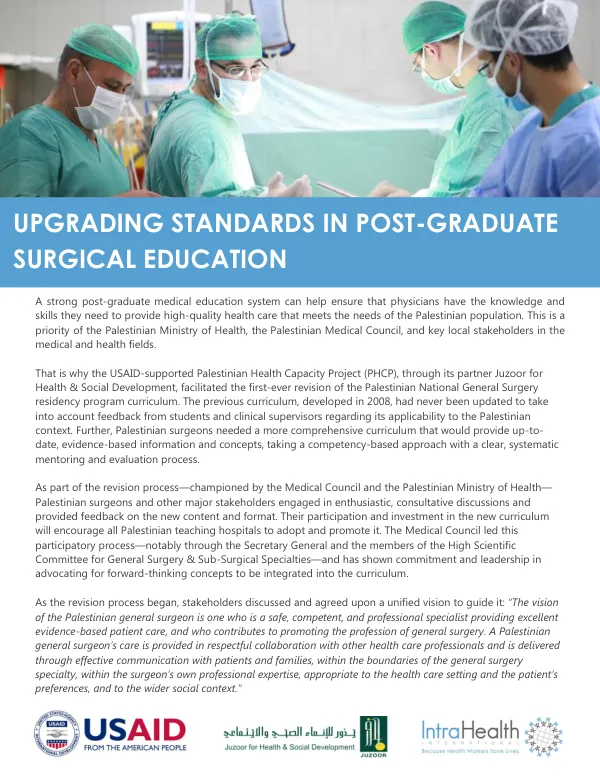
PHCP is a project implemented by IntraHealth International in partnership with Juzoor for Health and Social Development and funded by the United States Agency for International Development (USAID). The project's initiatives focus on three major systems: increasing the appropriateness and financial control of referrals, strengthening continuous professional development (CPD) and residency programs, and strengthening the effectiveness of health information system (HIS). The Palestinian National Residency Program began in 2008 under the auspices of the Palestine Medical Council (PMC). The PMC adopted the Arab Board of Health Specializations' accreditation criteria, including criteria for the general surgery specialization. However, despite basing residency programs on accreditation criteria, these programs faced challenges due to a lack of standardization of teaching competencies, inconsistency between different teaching programs, and a lack of focus on important non-technical skills. In 2014, the PMC, the Palestinian Ministry of Health (PMOH), and key stakeholders in the medical community identified the review of national medical residency programs as a priority issue. PHCP conducted an assessment of general surgery residency programs at four pilot hospitals where the updated curriculum would be implemented. The gap analysis identified deficiencies in the existing general surgery resident training, including a lack of structured programs, variations between teaching approaches and programs, and a lack of focus on non-technical skills. The assessment also revealed that not all residents had a log book, there was no regular follow-up on log books by residents or supervisors, and no internal/external audit process existed. Informed by the findings of the gaps assessment, PHCP engaged with multiple stakeholders to review and update the curriculum. The revision process was done with significant input and involvement from the PMC, headed by the Minister of Health, and other key stakeholders in the surgery community. Palestinian consultants, supported by an international colleague from the Royal College of Surgeons of Edinburgh, reviewed and elaborated the residency training curriculum to address key gaps and update the curriculum using international standards and competency frameworks, as well as the latest evidence-based knowledge and practices. The revised general surgery curriculum provides up-to-date, evidence-based information and concepts through a competency-based approach tailored to the local context. The resulting revised syllabus standardizes general surgery post-graduate medical education according to evidence-based knowledge and practices and is in line with the latest evidence-based updates. The syllabus outlines the knowledge, attitudes, behaviors, and skills that residents are expected to have acquired by the end of their specialty training in the General Surgery Palestinian National Residency Program. It also provides a detailed guide for the content of their training across all years of the program. The revised curriculum introduces a competency framework, known as "skills domains," to serve as a basis for post-graduate medical education in the country. The six skills domains agreed upon by stakeholders are: Surgical Specialty, Interpersonal and Communication Skills, Team Work and Inter-professional Collaboration, Leadership Promotion, Teaching and Learning, and Professionalism and Ethics. The skills domains emphasize the importance of non-technical skills, recognizing that in order to achieve the vision of the Palestinian surgeon outlined by stakeholders, education must be well-rounded. This can serve as a model for other specialty training programs that seek to update their programs and transform post-graduate medical education according to a competency-based approach.
Related documents