TEXAS A&M INTERNATIONAL UNIVERSITY
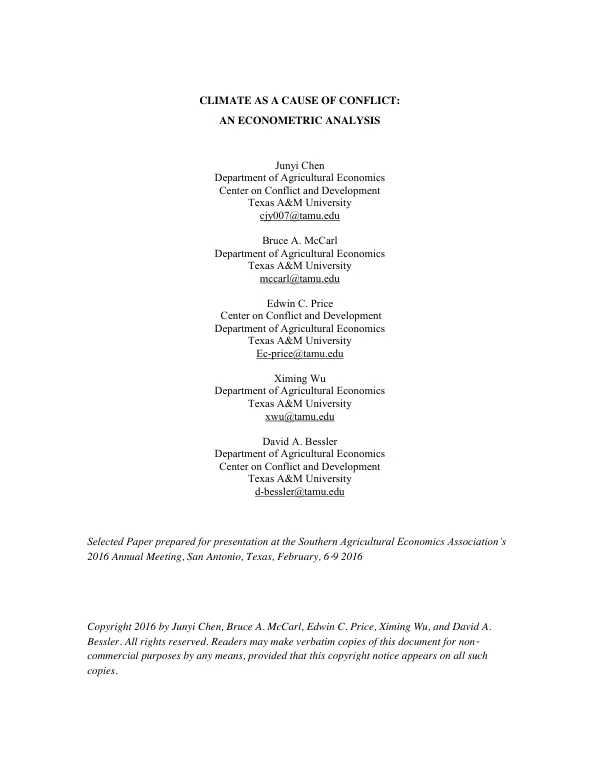
Climate as a Cause of Conflict: An Econometric Analysis
Climate as a Cause of Conflict: An Econometric Analysis Climate change and conflict pose significant threats to the economy, human welfare, and security.
2016 · 25 pages
Sign in to readA free account is required to download.
Abstract
A number of authors have argued that climate is one of the drivers of conflict, but there have been counterarguments. This study investigates the strength of the association between climate and conflict using a global dataset. The research aims to econometrically examine if climate directly or indirectly influences the probability of conflict and estimate the effects of projected climate change on conflict incidence. Numerous countries have suffered or are suffering from conflict in recent history, with devastating and long-lasting effects. Conflict has eroded physical assets, reduced services from natural assets, worsened economic conditions, weakened the labor force, and worsened social assets. The literature advances a set of diverse factors that can provoke conflict, including social, political, natural resource, economic, foreign aid, and climatic ones. However, there remains debate about the linkages and the strength of association among these items. The past few decades have witnessed unprecedented climate change, with an accelerating rising global average temperature, and observed regional changes in precipitation, extreme event frequency, and increasing sea level. A continuing degree of future climate change has been projected by many scientific groups. Substantial evidence indicates that climate change influences environmental and social systems. Observed climate change consequences include melting ice and snow, altered crop and livestock yields, declining populations of certain plants and animals, increased damages from pests, and exacerbated extreme event effects. It is suggested that climate conditions contribute to conflict. Climate change might reduce the availability of water and food, which can cause unrest, turning into violent conflict. Military planners term climate change as "a threat multiplier" in certain volatile regions. Given that climate conditions can cause food shortages, pest and disease expansion, and water scarcity, it is reasonable to expect climate change to trigger conflict. The Intergovernmental Panel on Climate Change (IPCC) examines evidence of the interconnection and calls for more research. The study employs a global dataset and applies both parametric and semiparametric techniques in a rolling window scheme, which allows for a system that evolves over time. Two criteria are employed to evaluate out-of-sample predictive capability of the estimated models. The investigation suggests that precipitation variation has a statistically significant effect on conflict. Generally, the study finds that the more this year's precipitation is smaller than last year's, the more likely civil conflict is. The literature review highlights the complexity of the climate-conflict relationship. Many studies have focused on linkages between temperature, precipitation, and conflict. Burke et al. (2009) conclude that there is a robust linkage between temperature and civil war in Africa with warmer years sparking wars. Gartzke (2012) examines relationships between global average temperatures and interstate conflict, but finds that climate is not necessarily a causal influence. Miguel et al. (2004) investigate the interrelationship between civil war and rainfall variability in Africa and find that a decline in rainfall can fuel conflict. The study's findings are consistent with previous research that suggests a link between climate and conflict. The results indicate that precipitation variation has a statistically significant effect on conflict, with a decline in precipitation increasing the likelihood of civil conflict. The study's conclusions are robust to different specifications and data sources, and the findings are consistent with the idea that climate change can indirectly affect the likelihood of conflict through various channels and manifold factors.