USAID DEC
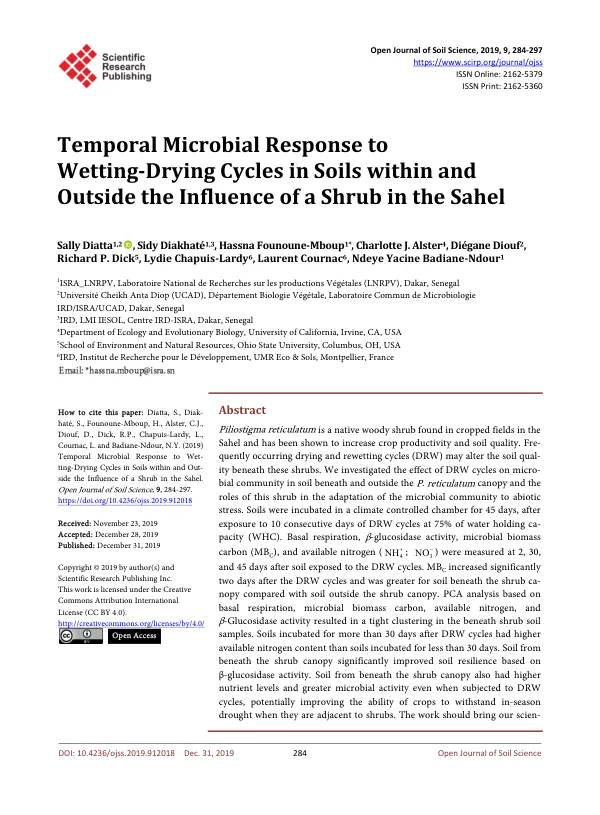
Temporal Microbial Response to Wetting-Drying Cycles in Soils within and Outside the Influence of a Shrub in the Sahel
Sign inOPEN UNIVERSITY
Temporal Microbial Response to Wetting-Drying Cycles in Soils within and Outside the Influence of a Shrub in the Sahel
The study investigated the effect of drying and rewetting cycles (DRW) on microbial communities in soils beneath and outside the canopy of Piliostigma reticulatum, a native woody shrub found in cropped fields in the Sahel.
2019 · 14 pages
Sign in to readA free account is required to download.
Abstract
The research aimed to determine the potential of long-term shrub presence in buffering impacts of severe disturbance on soil microbial activity. Piliostigma reticulatum has been shown to increase crop productivity and soil quality in the Sahel. The shrub creates "resource islands" through increased litter inputs and root activity/turnover, improving water distribution, nutrient abundance and availability, microbial habitat, and micro-environmental properties. Previous studies have demonstrated that soil around the shrubs maintains microbial diversity and activity, and drives nutrient mineralization and decomposition through the long dry season. The study was conducted in a laboratory experiment using microcosms with topsoil samples collected beneath and outside the shrub influence. The soils were incubated in a climatic chamber with controlled temperature and humidity, and subjected to repeated DRW cycles. The DRW cycles consisted of 10 hours of drying at 55°C, followed by 14 hours of incubation at 28°C and 75% field capacity. The results showed that microbial biomass carbon (MBC) increased significantly two days after the DRW cycles, and was greater for soil beneath the shrub canopy compared with soil outside the shrub canopy. Principal component analysis (PCA) revealed a tight clustering of soil samples from beneath the shrub canopy, indicating improved soil resilience based on β-glucosidase activity. Soils from beneath the shrub canopy also had higher nutrient levels and greater microbial activity, even when subjected to DRW cycles. The study suggests that long-term shrub presence can buffer against impacts of severe disturbance on soil microbial activity, and that the soil microbial communities can adapt to water stress. The findings have implications for the development of sustainable crop production systems in semi-arid ecosystems, and highlight the importance of considering the role of shrubs in maintaining soil health and fertility.
Related documents