USAID DEC
Conflict mitigation as a means of climate change adaptation: Lessons for policy and development practice
Sign inUNITED STATES INSTITUTE OF PEACE
Conflict mitigation as a means of climate change adaptation: Lessons for policy and development practice
Climate change and conflict are intricately linked, with conflict exacerbating climate change vulnerability and vice versa.
2024 · 14 pages
Sign in to readA free account is required to download.
Abstract
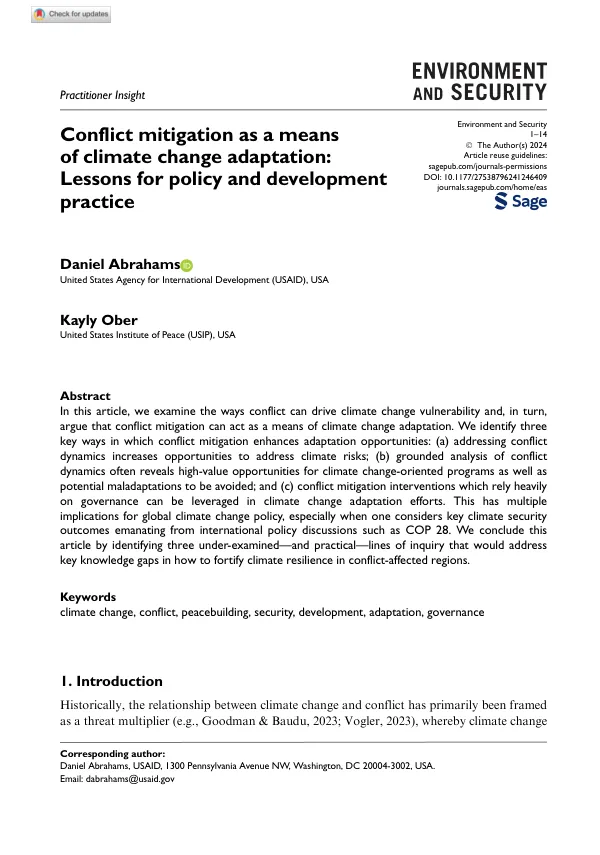
The relationship between climate change and conflict has historically been framed as a threat multiplier, where climate change exacerbates conflict risk through different pathways that link ecological shocks with social, cultural, and political risks. However, focusing solely on how climate change can affect conflict is limiting, and often elides the many ways in which conflict can increase vulnerability to climate change by decreasing adaptive capacity. Conflict can exacerbate climate change vulnerability by negatively altering local poverty rates and market functions, political inclusion, gender equity, and social cohesion. The impacts of conflict, both physical and institutional, further degrade the systems needed to remain resilient to climate shocks. Destruction of crops and other natural resources, curtailing livelihood options, degrading community support and social cohesion, increasing elite exploitation and local grievances, decreasing functioning of and trust in government and institutions, and shifting scales and sites of need are commonly identified ways that conflict worsens sensitivity, exposure, and/or adaptive capacity to climate change. The joint effects of climate change and conflict are reinforcing and act as a dual burden. The factors that make a place vulnerable to climate change are the very same factors that make a place vulnerable to conflict. The outcomes at the 28th Conference of Parties (COP 28) of the United Nations Framework for the Convention on Climate Change underscore how the international climate change policy community has begun to consider the unique climate risks facing conflict-affected areas. The Relief Recovery and Peace Act (COP 28, 2023) highlights the need to scale up financing in fragile and conflict-affected settings, consider how best to incorporate conflict-sensitive approaches to adaptation, enhance vulnerability mapping and information exchange, and lessen the technical and bureaucratic barriers to implementation. Conflict mitigation can act as a means of climate change adaptation, addressing conflict dynamics increases opportunities to address climate risks, grounded analysis of conflict dynamics often reveals high-value opportunities for climate change-oriented programs as well as potential maladaptations to be avoided, and conflict mitigation interventions which rely heavily on governance can be leveraged in climate change adaptation efforts. This has multiple implications for global climate change policy, especially when one considers key climate security outcomes emanating from international policy discussions such as COP 28. The case for conflict mitigation as a means of climate change adaptation is not yet fully made, and more research is needed to disentangle the pathways by which conflict underpins and exacerbates vulnerability to climate change. Understanding how the tools for examining, addressing, and measuring conflict and conflict sensitivity can be applied to climate change adaptation efforts is also crucial. Otherwise, we risk driving unintended consequences that can feed, rather than resolve, cycles of vulnerability.
Related documents