USAID
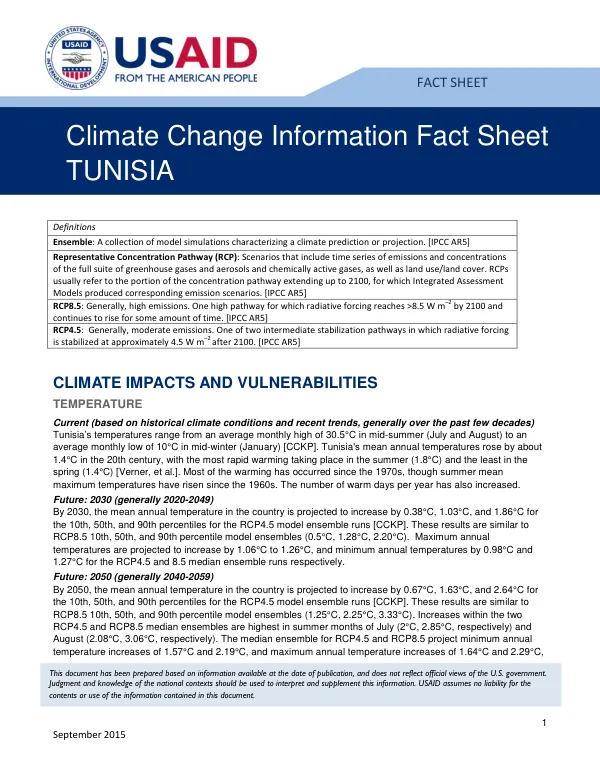
Climate Change Information Fact Sheet: Tunisia
Climate Change Impacts and Vulnerabilities in Tunisia Tunisia's temperatures range from an average monthly high of 30.5°C in mid-summer to an average monthly low of 10°C in mid-winter.
2015 · 4 pages
Sign in to readA free account is required to download.
Abstract
The country's mean annual temperatures rose by about 1.4°C in the 20th century, with the most rapid warming taking place in the summer and the least in the spring. Most of the warming has occurred since the 1970s, though summer mean maximum temperatures have risen since the 1960s. The number of warm days per year has also increased. By 2030, the mean annual temperature in Tunisia is projected to increase by 0.38°C, 1.03°C, and 1.86°C for the 10th, 50th, and 90th percentiles for the RCP4.5 model ensemble runs. These results are similar to RCP8.5 10th, 50th, and 90th percentile model ensembles (0.5°C, 1.28°C, 2.20°C). Maximum annual temperatures are projected to increase by 1.06°C to 1.26°C, and minimum annual temperatures by 0.98°C and 1.27°C for the RCP4.5 and 8.5 median ensemble runs, respectively. By 2050, the mean annual temperature in Tunisia is projected to increase by 0.67°C, 1.63°C, and 2.64°C for the 10th, 50th, and 90th percentiles for the RCP4.5 model ensemble runs. These results are similar to RCP8.5 10th, 50th, and 90th percentile model ensembles (1.25°C, 2.25°C, 3.33°C). Increases within the two RCP4.5 and RCP8.5 median ensembles are highest in summer months of July and August, with projected temperature increases of 2°C and 2.85°C, respectively. Precipitation and Flooding There is a notable difference between mean annual rainfall from the south (less than 100 mm on the margins of the Sahara) to north (more than 700 mm on the Mediterranean coast). Over the last few decades, the northern regions of North Africa (including Tunisia) have experienced a significant decrease in the amount of precipitation received in winter and early spring. The observed record also indicates greater than 330 dry days (with less than 1 mm day rainfall) per year over a 1997–2008-time period. The median ensemble runs for RCP4.5 and 8.5 indicate an average annual rainfall change of 0 mm/day, and -0.1mm/day, by the middle of the 2030s. By 2030, the RCP4.5 10th percentile (-29%), median (-3.3%), and 90th percentile (25%) ensembles for mean annual precipitation indicate high uncertainty in the direction and amount of change across the models. These results are similar to RCP8.5 (-31%, -2.4%, and 27%). At mid-century, the median ensemble for RCP4.5 and RCP8.5 project mean annual rainfall reductions of -4.1% and -6.8%, respectively. Though, the 10th percentile ensembles for RCP4.5 and 8.5 project larger reductions (-36%), and the 90th percentile ensembles project mean annual increases (27% and 26%). A reduction in rainfall over northern Africa is very likely by the end of the 21st century. Drought Nearly two-thirds of Tunisia is semiarid to arid, where drought can be frequent. Drought episodes have been traced back to the sixth century in Tunisia, and the country has experienced 23 dry years from 1907 to 1997. Most recently, Tunisia experienced drought in 1982, 1987 to 1989, 1993 to 1995, and its worst drought in over 50 years from 1999 to 2002. Estimates are highly uncertain and information is not readily available for future drought conditions. However, the combination of higher temperatures and declining rainfall (A2 and B1 scenarios) is projected to reduce water resources in Tunisia. Projections also suggest a drying trend in the region, particularly along the Mediterranean coast, driven by large decreases expected in summertime precipitation. North Africa would be particularly affected by droughts that would be more frequent, more intense, and longer-lasting. Drought would be more frequent in summer than in winter. Sea Level Rise and Storm Surge Sea levels have risen across the Mediterranean by an average of more than 3.1 mm each year since 1992, although records from further back indicate considerable local variability. One array of tide gauges indicates that since 1990, Mediterranean Sea