USAID DEC
Climate Change Vulnerability Assessment and Adaptation Planning for Mwembeni Village, Pangani District, Tanzania
Sign inCOASTAL RESOURCES CENTER
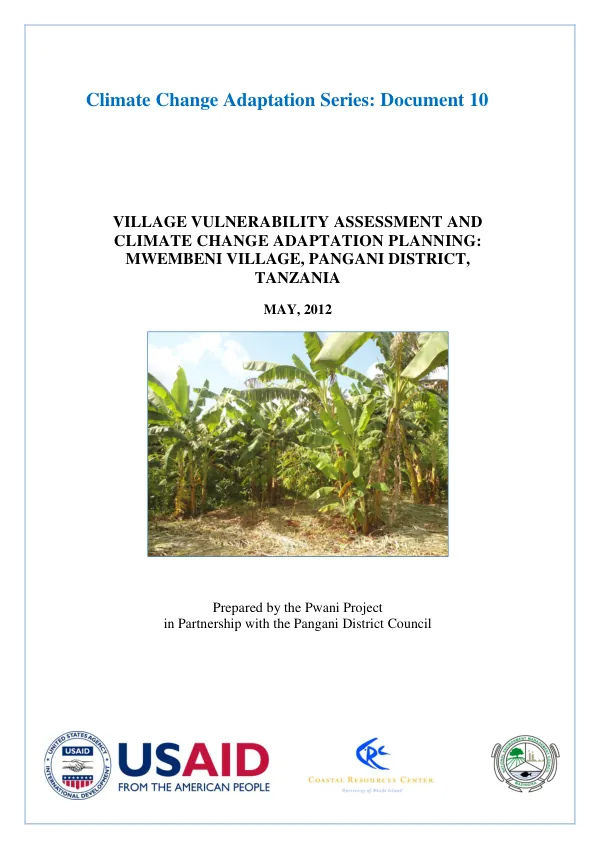
Climate Change Vulnerability Assessment and Adaptation Planning for Mwembeni Village, Pangani District, Tanzania
Climate change and increased climate variability are already occurring and having serious consequences for many African countries, including Tanzania.
2012 · 28 pages
Sign in to readA free account is required to download.
Abstract
Predictions from experts indicate that the problems caused by climate change will increase, making management of coastal ecosystems and improvements to community resilience even more difficult. The following threats are predicted to cause major problems for coastal resources and the well-being, safety, and food security of coastal communities: more unpredictable precipitation, increases in strong storms, sea level rise, increased sea surface and ambient air temperatures, and increased ocean acidification. These climate and chemical threats and the problems they create are on top of and in addition to existing local stresses. In most of coastal Tanzania, these include deforestation, overfishing, deterioration in water supply and quality, and development pressures. The Pwani Project, initiated in 2010, aims to help local leaders and government assess climate change impacts and find ways to adapt to current and future climate change impacts in a strategic way using their own resources and knowledge. Mwembeni Village, located in Pangani District, was selected for village-level vulnerability and assessment planning (V&A) due to evident livelihood impacts from climate change, active village leadership and interest, and the potential for identifying small doable adaptation actions. The village has an area of 1,127 hectares and a population of 1,042 living in 316 households. The specific objectives of the Mwembeni V&A include developing awareness and understanding of the concept of climate change, natural processes, and anthropogenic causes of shoreline and ecosystem change, promoting good practices of shore management and small-scale agriculture, and identifying doable climate change adaptation actions. The vulnerability assessment and adaptation planning followed the guidance of the USAID report "Adapting to Coastal Climate Change: A Guidebook for Development Planners" prepared by the Coastal Resources Center at the University of Rhode Island. The V&A applied Participatory Rapid Appraisal (PRA) tools and used focus group techniques for obtaining information from the community. The village government identified 37 representative community members to participate in the V&A, who represented Village Government, Village Council Members, respected village members, and 12 villagers who were selected to form a village Climate Change Committee. The village's adaptive capacity is influenced by its exposure to climate change, sensitivity to its impacts, and ability to cope with actual or expected changes. The community's assets at risk include land, infrastructure, and human society. The degree to which these assets are sensitive to incurring negative impacts from climate change and climate variability is a key factor in determining the village's vulnerability. The Mwembeni V&A identified several climate and non-climate threats and impacts affecting the village, including more unpredictable precipitation, increases in strong storms, sea level rise, and increased sea surface and ambient air temperatures. The community's adaptive capacity is influenced by its exposure to these threats, sensitivity to their impacts, and ability to cope with actual or expected changes. The village's economy and society are also affected by climate change, with livelihoods and rural economy being key areas of concern. The community's attention to the needs of marginalized groups is also important, as they are often the most vulnerable to climate change impacts. The Mwembeni V&A aims to promote good practices of shore management and small-scale agriculture, and identify doable climate change adaptation actions to reduce harm or exploit beneficial opportunities. The village's governance and leadership play a crucial role in its adaptive capacity, with the village government and Climate Change Committee being key stakeholders in the V&A process. The community's risk awareness and emergency response capacity are also important, with public awareness of local conditions and emergency preparedness being key areas of concern. The Mwembeni V&A has identified several adaptation actions that can be taken to reduce the village's vulnerability to climate change, including promoting good practices of shore management and small-scale agriculture, and identifying doable climate change adaptation actions. The community's adaptive capacity will be influenced by its exposure to climate change, sensitivity to its impacts, and ability to cope with actual or expected changes.