USAID DEC
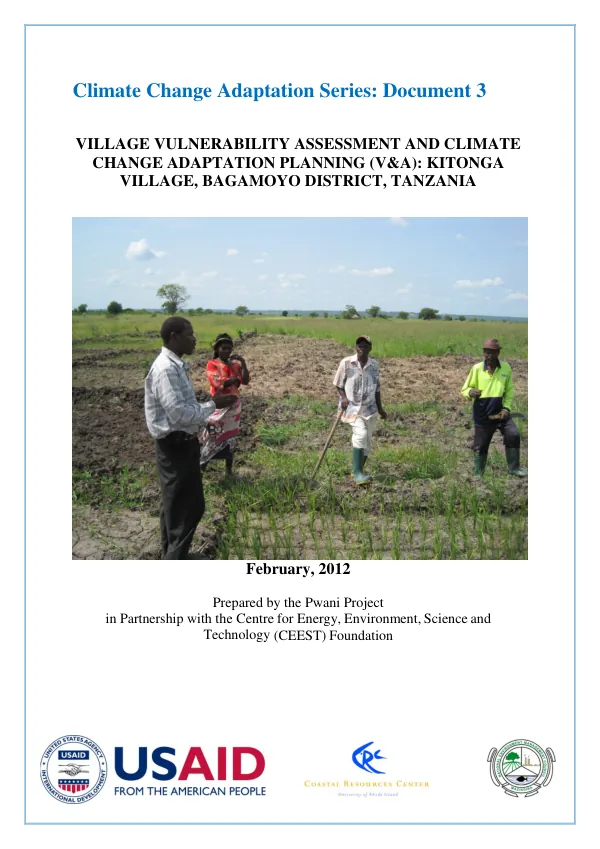
Village-Level Vulnerability Assessment and Climate Change Adaptation Planning (V&A) for Kitonga Village, Bagamoyo District, Tanzania
Sign inCOASTAL RESOURCES CENTER
Village-Level Vulnerability Assessment and Climate Change Adaptation Planning (V&A) for Kitonga Village, Bagamoyo District, Tanzania
The Pwani Project initiated an effort to help local leaders and government assess climate change impacts and find ways to adapt to current and future climate change impacts in a strategic way using their own resources and knowledge.
2012 · 18 pages
Sign in to readA free account is required to download.
Abstract
This effort is part of a larger coastal management effort in a partnership with the government of Tanzania and the United States Agency for International Development (USAID). The overall goal is to help sustain the flow of environmental goods and services, revise the trend of environmental destruction of critical coastal habitats, and improve the wellbeing of coastal residents in the Bagamoyo-Pangani and Menai Bay Seascapes. The initial work on climate change targeted two coastal, rural villages in Bagamoyo District – Mlingotini and Kitonga. Kitonga is not directly on the coast, but is in the flood plain of the Ruvu River. People in Kitonga are very dependent on the natural resource base for agriculture, especially rain-fed rice farming, vegetables, and fruits. In these rural villages, people are close to the sea, the rise and ebb of the tide, and the seasonality of rain and prevailing winds. They are aware of climate change and climate variability and how it is impacting their lives. A Community Climate Change Committee (4C) was formed in Kitonga village, consisting of 12 members, with an equal number of men and women. The specific objectives of the village-level vulnerability assessment and adaptation planning (V&A) include developing awareness and understanding of climate change impacts, vulnerability, and adaptation options, finding local champions for climate change adaptation actions, demonstrating low-cost, low-technology methods for vulnerability assessment and adaptation planning, and sharing experience and best practices across villages and with District government. Vulnerability is defined as the degree to which a human or natural system is susceptible to, or unable to cope with, adverse effects of climate change. Vulnerability is a function of the character, magnitude, and rate of climate variation to which a system is exposed, its sensitivity, and its adaptive capacity. The V&A exercise sought to understand the potential impact of climate change and climate variability and develop an initial list of response options (planned adaptation measures). Kitonga was selected because of its vulnerability to climate change threats and locally expressed interest in assessing climate change and finding ways to limit harmful impacts. Kitonga village is located close to the Ruvu River and is influenced by river flooding events. The village was formally a sub-village of Kidogozero village but is now a registered village with 5 sub-villages. The Pwani Project, in partnership with District government staff and CEEST, a local NGO, began a process of meeting with and working with village leadership in Kitonga to conduct a village-level climate change vulnerability assessment and adaptation planning (V&A). The V&A exercise involved a series of focus group discussions, surveys, and interviews with community members to gather information on climate change impacts, vulnerability, and adaptation options. The results of the V&A exercise identified several climate change threats and impacts affecting Kitonga village, including more unpredictable precipitation, increases in strong storms, sea level rise, increased sea surface and ambient air temperatures, and increased ocean acidification. The exercise also identified several vulnerability factors, including deforestation, overfishing, deterioration in water supply and quality, and development pressures. The V&A exercise developed an initial list of response options (planned adaptation measures) to address the climate change threats and impacts identified in Kitonga village. These response options include establishing a mango fruit tree planting orchard, promoting sustainable agriculture practices, and improving water management systems. The exercise also identified several opportunities for adaptation, including the potential for increased agricultural productivity and improved food security. The Pwani Project intends to transfer and build on the lessons learned from this experience in V&A to other coastal villages in the Pwani Project area. The overall goal is to maintain healthy coastal ecosystems and reduce the harmful effects of climate change impacts on coastal communities.
Related documents