USAID DEC
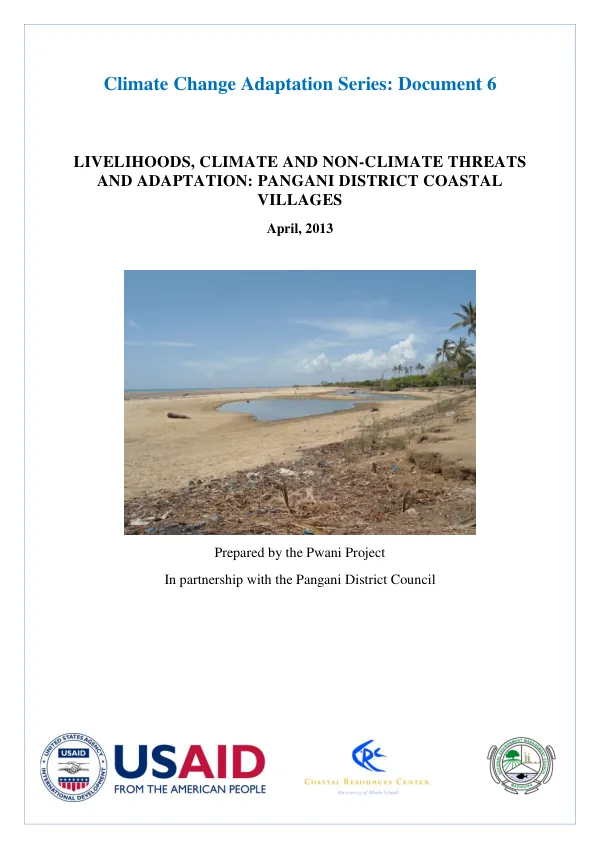
Livelihoods, Climate and Non-Climate Threats and Adaptation: Pangani District Coastal Villages
Sign inCOASTAL RESOURCES CENTER
Livelihoods, Climate and Non-Climate Threats and Adaptation: Pangani District Coastal Villages
Climate change and increased climate variability are already occurring and having serious consequences for many African countries, including Tanzania.
2013 · 34 pages
Sign in to readA free account is required to download.
Abstract
Predictions from experts on climate change indicate that the problems caused by climate change will increase, making management of coastal ecosystems and improvements to community resilience even more difficult. The following threats are predicted to cause major problems for coastal resources and the well-being, safety, and food security of coastal communities: more unpredictable precipitation, increases in strong storms, sea level rise, increased sea surface and ambient air temperatures, and increased ocean acidification. These climate and chemical threats and the problems they create are in addition to existing local stresses such as deforestation, overfishing, deterioration in water supply and quality, and development pressures. The University of Rhode Island's Pwani Project initiated an effort in 2010 to help local leaders and government assess climate change impacts and find ways to adapt to current and future climate change impacts in a strategic way using their own resources and knowledge. Pangani District is one of the seven districts in Tanga Region, with a total of 33 villages, coastal and terrestrial combined, which all together have 95 sub-villages. The district has a population of 43,920, according to the 2002 census. The District headquarters are located in Pangani Town, the largest urban center, which has been an important port, commercial, and administrative center at the mouth of the Pangani River since the arrival of Arab and Persian traders and during German colonial development in the 19th and early 20th century. The Pwani Project has a geographic focus on the island of Unguja in Zanzibar and the ecologically important northern coast of mainland Tanzania – Bagamoyo and Pangani Districts. The overall goal is to help sustain the flow of environmental goods and services, revise the trend of environmental destruction of critical coastal habitats, and improve the wellbeing of coastal residents in the Bagamoyo-Pangani and Menai Bay Seascapes. Climate change is a shift in the pattern of weather averaged over time due to natural variability or because of human activity. Vulnerability is the degree to which a human or natural system is susceptible to, or unable to cope with, adverse effects of climate change. It is a function of the types and amount of assets at risk (exposure), the degree to which those assets and people are impacted (sensitivity), and the ability to cope with actual or expected changes (adaptive capacity). Exposure refers to assets (land, infrastructure, human society) at risk to the impact of climate change, while sensitivity is the degree to which assets are sensitive to incurring negative impacts. The Pwani Project has been working with local leaders and government to assess climate change impacts and find ways to adapt to current and future climate change impacts in a strategic way using their own resources and knowledge. The project has a geographic focus on the island of Unguja in Zanzibar and the ecologically important northern coast of mainland Tanzania – Bagamoyo and Pangani Districts. The overall goal is to help sustain the flow of environmental goods and services, revise the trend of environmental destruction of critical coastal habitats, and improve the wellbeing of coastal residents in the Bagamoyo-Pangani and Menai Bay Seascapes. The report focuses on six coastal communities in Pangani District, which are exposed to climate change and non-climate related stresses. The impacts pose danger to livelihoods, social assets, and the natural environment. The report seeks to understand the vulnerabilities specific to these communities in order to provide guidance for planning directed at improving livelihood resilience and reducing vulnerability in communities to climate and non-climate stressors.
Related documents