USAID DEC
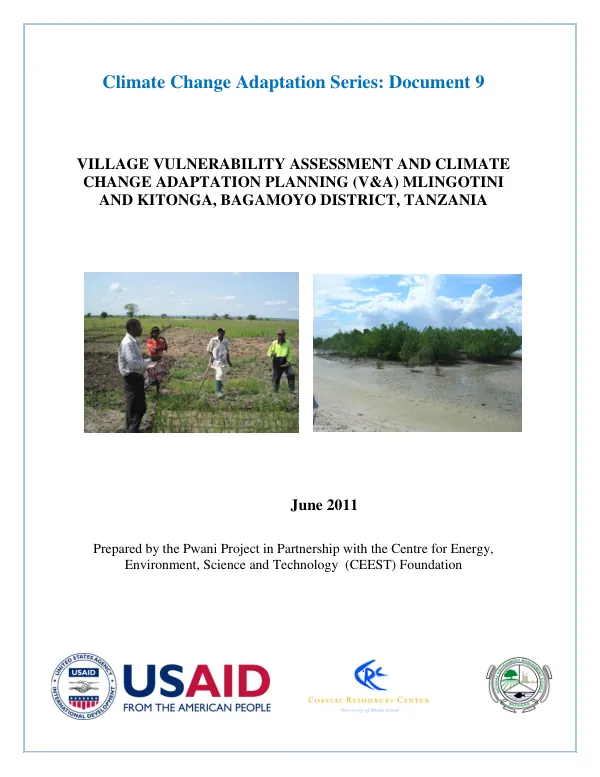
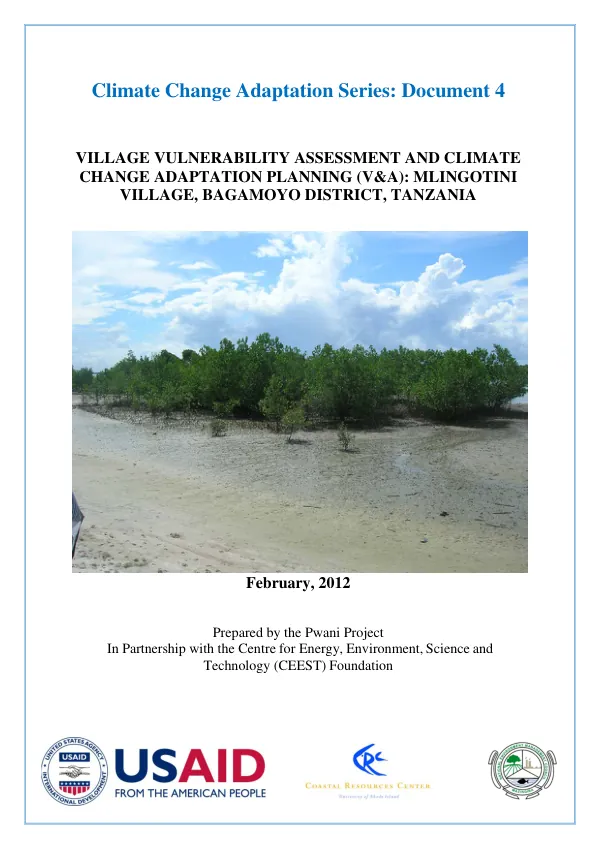
Village Vulnerability Assessment and Adaptation Planning: Mlingotini, Bagamoyo District, Tanzania.
Sign inCOASTAL RESOURCES CENTER
Village Vulnerability Assessment and Adaptation Planning: Mlingotini, Bagamoyo District, Tanzania.
Climate change and increased climate variability are having serious impacts on many African countries, including Tanzania.
2012 · 24 pages
Sign in to readA free account is required to download.
Abstract
Predictions from experts indicate that these problems will increase and make management of coastal ecosystems and community resilience even more difficult. The following climate-related issues are expected to cause major problems for coastal resources and the well-being, safety, and food security of coastal communities: 1. More unpredictable precipitation (seasonality and intensity) 2. Increases in strong storms 3. Sea level rise 4. Increased sea surface and ambient air temperatures 5. Increased ocean acidification These climate and chemical threats are in addition to existing local stresses, including deforestation, overfishing, deterioration in water supply and quality, and development pressures. The Pwani Project, in partnership with the government of Tanzania and the United States Agency for International Development (USAID), initiated an effort to help local leaders and government assess climate change impacts and find ways to adapt to current and future climate change impacts. The project has a geographic focus on the island of Unguja in Zanzibar and the northern coast of mainland Tanzania, specifically Bagamoyo and Pangani Districts. The overall goal is to sustain the flow of environmental goods and services, reverse the trend of environmental destruction of critical coastal habitats, and improve the well-being of coastal residents in the Bagamoyo-Pangani and Menai Bay Seascapes. The initial work on climate change targeted two coastal, rural villages in Bagamoyo District - Mlingotini and Kitonga. Mlingotini village is located on the Indian Ocean, sheltered by the Mlingotini Bay, also known as the Lazy Lagoon. The village's livelihoods are predominantly resource-based, including traditional fishing, seaweed farming, small-scale agriculture, and small-scale ecotourism. A Climate Change Committee was formed in each village, consisting of 12 members, with an equal number of men and women. The committee's specific objectives include developing understanding of climate change impacts, vulnerability, and adaptation options, finding local champions for climate change adaptation actions, demonstrating low-cost, low-technology methods for vulnerability assessment and adaptation planning, and sharing experience and best practices with District government. The overall goal of the project is to maintain healthy coastal ecosystems and reduce the harmful effects of climate change impacts on coastal communities. The Pwani project aims to build on the lessons learned from this experience and apply them to other coastal villages in the project area. Vulnerability is defined as the degree to which a system is susceptible to, or unable to cope with, adverse effects of climate change. It is a function of the magnitude, rate, and exposure to climate variation, as well as the system's adaptive capacity. The USAID report "Adapting to Coastal Climate Change: A Guidebook for Development Planners" guided the vulnerability assessment exercise, which aimed to identify the potential impact of climate change and climate-related stressors on the two villages. The assessment process involved several steps, including data collection, analysis, and interpretation. The data was collected through a combination of methods, including household surveys, focus group discussions, and key informant interviews. The data was analyzed using a variety of techniques, including statistical analysis and thematic analysis. The assessment identified several climate-related stressors that are affecting the two villages, including sea level rise, increased storm intensity, and changes in precipitation patterns. The assessment also identified several vulnerabilities, including the lack of access to climate information, limited capacity for adaptation, and the reliance on climate-sensitive livelihoods. The assessment recommended several adaptation options, including the implementation of early warning systems, the development of climate-resilient agriculture practices, and the promotion of climate-resilient infrastructure. The assessment also recommended the establishment of a climate change committee in each village, which would be responsible for coordinating climate change adaptation efforts. The Pwani Project aims to build on the lessons learned from this experience and apply them to other coastal villages in the project area. The project will continue to work with local leaders and government to develop and implement climate change adaptation plans that are tailored to the specific needs and circumstances of each village.
Related documents