CATHOLIC RELIEF SERVICES ORGANIZATION
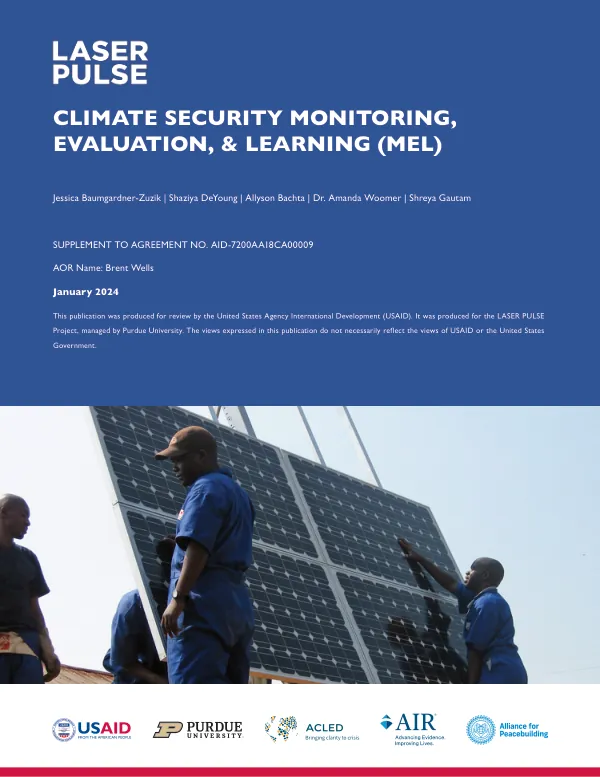
Climate Security Monitoring, Evaluation, and Learning (MEL) Report
Climate security programming across the broader peacebuilding and climate landscape has been a subject of increasing interest in recent years.
2023 · 26 pages
Sign in to readA free account is required to download.
Abstract
The research summarized in this report aims to better understand the current state of measurement in this field. The report explores the general characteristics of climate security studies to date, including explicit indicators, common measurement trends, and indicator examples. The studies analyzed for this report were curated from a climate security evidence review that contained 103 resources covering 128 programs related to climate security. Of these, 16 (12.5%) contained explicit indicators, which were synthesized within the body of this report. This catalogue reflects the limited evidence base in the field, with most of the resources identified being academic and gray literature that examine programmatic efforts. A total of 209 indicators were extracted for analysis, which collectively depict that climate security involves a combination of thematic indicators. Each of these indicators plays a role in understanding the multifaceted nature of environment, conflict, and human systems. The findings from the climate security studies reveal a broad spectrum of measures that resonate with varied themes, predominantly focused on measuring changes related to environmental and human systems or programmatic operations. The indicators encompass a holistic view of environment and human systems, from assessing the intricate interplay of agricultural practices and land tenure in environmental indicators to delving into the realms of conflict, well-being, and economic facets in human systems. Based on this, a nuanced understanding of climate security can be gained, highlighting the need for a comprehensive approach that considers the complex relationships between environmental, social, and economic factors. The research also highlights the importance of measuring changes related to environmental and human systems, as well as programmatic operations. This suggests that climate security programs are seeking to change a range of outcomes, including environmental degradation, conflict, and human well-being. However, the report notes that there is a lack of explicit indicators in the field, which makes it challenging to measure and evaluate the effectiveness of climate security programs. The report concludes by emphasizing the need for further research and development of explicit indicators in the field of climate security. This will enable more effective measurement and evaluation of climate security programs, ultimately contributing to improved outcomes and a more comprehensive understanding of the complex relationships between environment, conflict, and human systems. The research methodology used in this report involved a comprehensive review of existing literature on climate security, including academic and gray literature. The report analyzed 103 resources covering 128 programs related to climate security, extracting 209 indicators for analysis. The indicators were categorized into thematic areas, including environmental indicators, human systems indicators, contextual indicators, and measurement indicators. The report also highlights the importance of emerging resources in climate security, including new studies and research findings that can inform the development of explicit indicators. The report concludes by emphasizing the need for continued research and development in the field of climate security, with a focus on improving measurement and evaluation capabilities. In terms of geographic reach, the report notes that climate security programs are being implemented in a range of countries and regions, including those with high levels of conflict and environmental degradation. The report highlights the importance of considering the local context and needs of each country or region when designing and implementing climate security programs. The report also emphasizes the need for a comprehensive approach to climate security, one that considers the complex relationships between environmental, social, and economic factors. This approach will enable more effective measurement and evaluation of climate security programs, ultimately contributing to improved outcomes and a more comprehensive understanding of the complex relationships between environment, conflict, and human systems. In terms of implementation, the report notes that climate security programs are being implemented through a range of mechanisms, including government agencies, non-governmental organizations, and community-based initiatives. The report highlights the importance of building partnerships and collaborations between different stakeholders to support the effective implementation of climate security programs. The report concludes by emphasizing the need for continued research and development in the field of climate security, with a focus on improving measurement and evaluation capabilities. This will enable more effective measurement and evaluation of climate security programs, ultimately contributing to improved outcomes and a more comprehensive understanding of the complex relationships between environment, conflict, and human systems.