USAID DEC
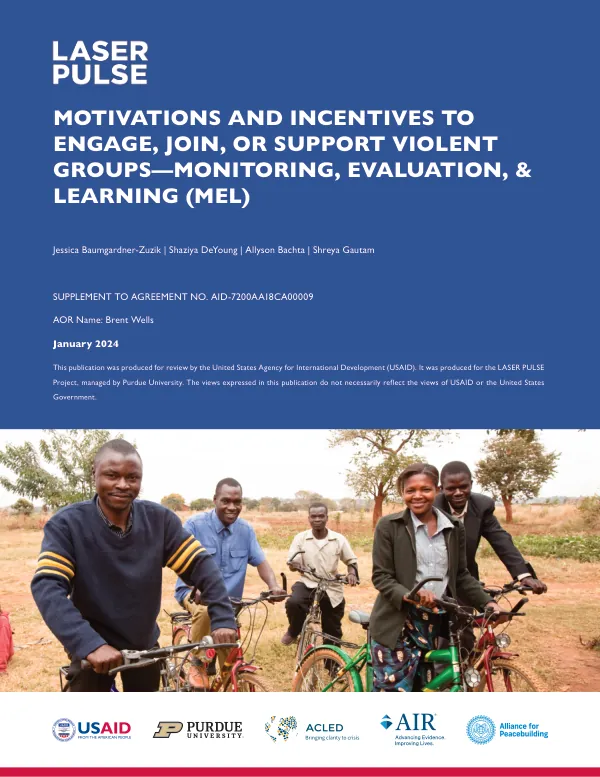
Evidence Review on the Motivations and Incentives to Engage, Join or Support Violent Groups
Sign inCATHOLIC RELIEF SERVICES ORGANIZATION
Evidence Review on the Motivations and Incentives to Engage, Join or Support Violent Groups
The motivations and incentives to engage, join, or support violent groups are complex and multifaceted.
2023 · 28 pages
Sign in to readA free account is required to download.
Abstract
Research suggests that individuals and groups are often driven by a combination of factors, including economic, social, and political grievances. Chronic violence and instability can create an environment in which violent groups can thrive, and individuals may feel compelled to join or support these groups as a means of survival or self-protection. Studies have identified several key drivers of conflict and violence, including social patterns that emerge when interactions between identities, institutions, narratives, social norms, values, and interests generate sufficient dissatisfaction or incentives that individuals and groups seek to achieve their objectives through confrontation or violent means. These drivers can be influenced by a range of factors, including climate change, which can exacerbate existing social and economic tensions and create new sources of conflict. Conflict sensitivity is a critical component of addressing violent extremism and promoting peace and stability. This approach involves understanding how aid interacts with conflict in a particular context, to mitigate unintended negative effects, and to influence conflict positively wherever possible, through humanitarian, development, and/or peacebuilding interventions. By taking a conflict-sensitive approach, aid programs and activities can be designed to address the root causes of conflict and promote more peaceful and resilient communities. Research has also highlighted the importance of addressing the social and economic drivers of conflict and violence, including poverty, inequality, and social exclusion. Interventions that focus on promoting economic opportunities, improving access to education and healthcare, and enhancing social cohesion can help to reduce the appeal of violent groups and promote more peaceful forms of social and political engagement. The integration of conflict-sensitive practice within human-serving sectors is critical to addressing the complex and multifaceted nature of violent extremism. This approach involves understanding the context in which aid is being distributed, including the physical, geographic, socio-economic, and demographic characteristics, as well as the existing institutions and an area's history of conflict and violence. By taking a conflict-sensitive approach, aid programs and activities can be designed to address the root causes of conflict and promote more peaceful and resilient communities. Studies have identified several key interventions and outcomes that are critical to addressing violent extremism and promoting peace and stability. These include promoting economic opportunities, improving access to education and healthcare, enhancing social cohesion, and addressing the social and economic drivers of conflict and violence. By implementing these interventions and outcomes, aid programs and activities can help to reduce the appeal of violent groups and promote more peaceful forms of social and political engagement. The review also highlights the importance of addressing the social and economic drivers of conflict and violence, including poverty, inequality, and social exclusion. Interventions that focus on promoting economic opportunities, improving access to education and healthcare, and enhancing social cohesion can help to reduce the appeal of violent groups and promote more peaceful forms of social and political engagement. By implementing these interventions and outcomes, aid programs and activities can help to promote more peaceful and resilient communities and reduce the risk of violent extremism.