USAID. MISSION TO HONDURAS
Clinic expansion program
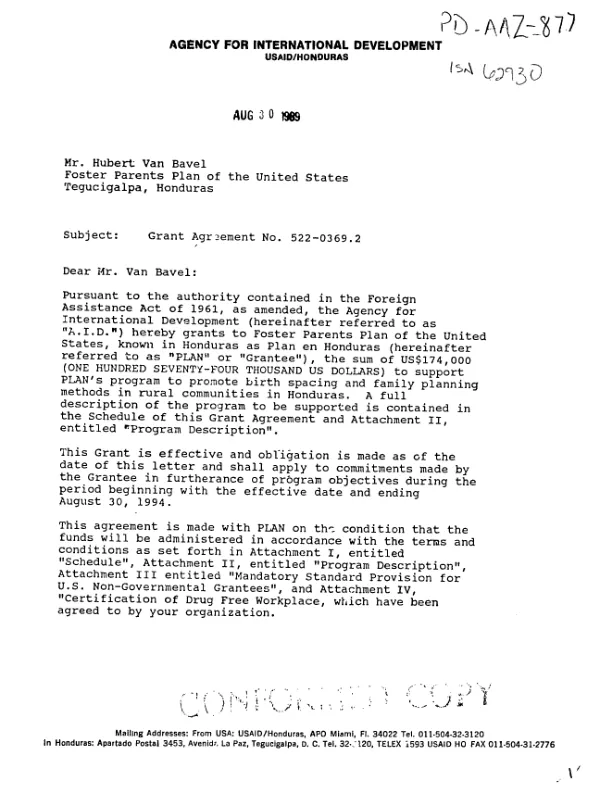
Project, building on project 5220175, to increase the availability of surgical sterilization and expand the existing community-based contraceptive distribution (CBD) program in rural Honduras.
1982
Sign in to readA free account is required to download.
Abstract
The project will be implemented by the Honduran Family Planning Association (ASHONPLAFA) with technical and advisory assistance from the U.S. Center for Disease Control and the Association for Voluntary Sterilization. Because much of the clinic expansion program will be carried out in Ministry of Health (MOH) clinics, ASHONPLAFA"s role in implementing this component will consist of coordinating with the MOH, procuring equipment, contracting new personnel, and monitoring program progress. Five full-time and two part-time promoters will be trained and employed to provide community education and to facilitate access to surgical sterilization programs in Comayagua, rural Tegucigalpa, rural San Pedro Sula, Trujillo, Yoro, El Progresso, Siguatepeque, and El Mochito. An experimental program will be established to defray the cost of public transportation where such costs prohibit women"s access to sterilization. In Tegucigalpa, a clinical laboratory will be established to process laboratory specimens and, in turn, allow the Centro Medico Quirurgico to perform more sterilizations at a lower per patient cost (average cost should fall from $73 to $50). Hospital room maintenance equipment, particularly clothes dryers, will be purchased for Hospital Tela Integrado and Hospital de Occidente in Santa Rosa de Copan, thus allowing more efficient sterilization procedures, especially during the rainy season. In addition, Hospital Escuela in Tegucigalpa, which currently provides no sterilization services, will hire two full-time nurses and a promoter in order to begin performing sterilizations daily. Regarding the CBD program, trained maintenance, expansion, and supervision teams will supply contraceptives, maintain records, and support a growing number of rural contraceptive distributors - an increase in distribution points from 700 to 1,200 and in CBD program participants from 27,000 to 100,000. Trained educators and promoters will provide and expand community education and family planning advice to new, primarily rural areas.
Related documents