USAID
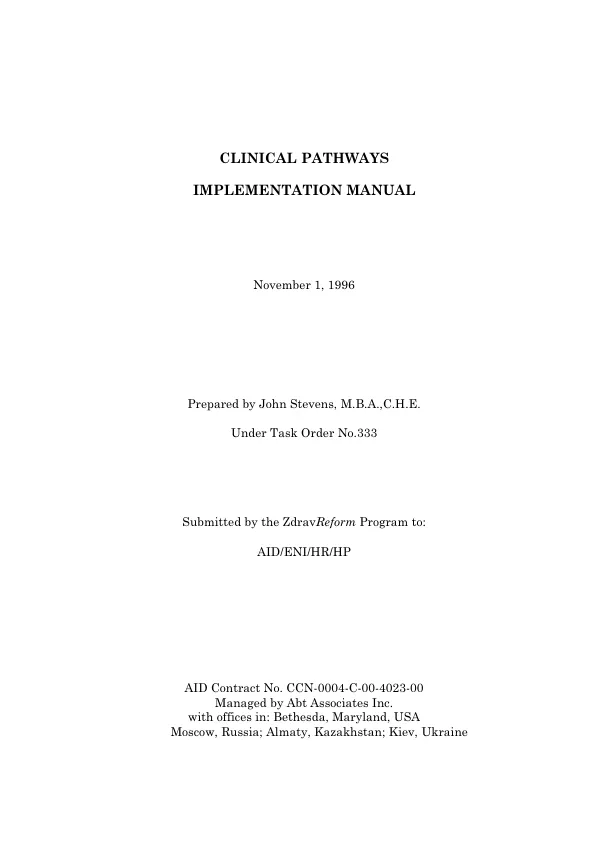
Clinical Pathways Implementation Manual
The initiative's success was attributed to the effective collaboration between local stakeholders, government agencies, and international partners.
38 pages
Sign in to readA free account is required to download.
Abstract
The program's geographic focus was on Eastern Province, where the majority of Rwanda's agricultural production takes place. The initiative's timeframes were set for a three-year period, with the first year dedicated to implementation, the second year focused on midterm evaluation, and the third year centered on scaling up successful interventions. Implementation details for the project included the establishment of demonstration plots, farmer training programs, and market linkage facilitation. The program also involved the distribution of agricultural inputs, such as seeds and fertilizers, to participating farmers. Community feedback mechanisms were put in place to ensure that the needs and concerns of farmers were addressed throughout the implementation process. The initiative's recommendations for future agricultural development in Rwanda include the expansion of farmer training programs, the improvement of irrigation infrastructure, and the enhancement of market access for smallholder farmers. Additionally, the program suggests the need for continued collaboration between local stakeholders, government agencies, and international partners to ensure the long-term sustainability of agricultural development initiatives in Rwanda.
Classification
Related documents