DEVELOPMENT ALTERNATIVES, INC./FINNET
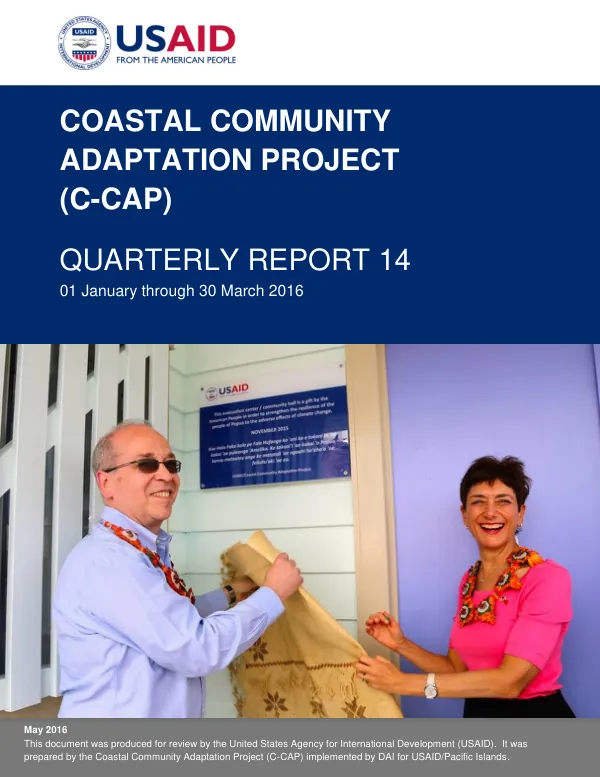
Coastal Community Adaptation Project (C-CAP) Quarterly Report 14
The Coastal Community Adaptation Project (C-CAP) is a USAID-funded initiative implemented by DAI in partnership with the University of the South Pacific's Pacific Center for Environment and Sustainable Development (PACE-SD).
2016 · 59 pages
Sign in to readA free account is required to download.
Abstract
The project's primary objective is to build the resilience of vulnerable coastal communities in the Pacific region to withstand more intense and frequent weather events and ecosystem degradation in the short term, and sea level rise in the long term. The project works directly with coastal communities across the Pacific Islands region to rehabilitate or construct new, small-scale community infrastructure that is resilient to the impacts of climate change. C-CAP also builds capacity for disaster prevention and preparedness through community-based training and participatory risk mapping and analysis. The project focuses on nine Pacific Island countries, including Fiji, Kiribati, Nauru, Papua New Guinea, Samoa, Solomon Islands, Tonga, Tuvalu, and Vanuatu. C-CAP is comprised of three major technical components: Component 1, Component 2, and Component 3. Component 1 focuses on improving coastal zone management and water resource management capacity. This component includes tasks such as identifying and prioritizing districts and coastal communities for participation and activities, developing a network of Social Mobilizers, and developing criteria to identify and prioritize community-specific social and economic infrastructure activities. Component 2 aims to strengthen disaster management. This component includes tasks such as risk identification, options identification, and risk reduction. Task 2.1 involves developing or updating locally tailored assessments to improve understanding of current and future risks. Task 2.2 involves identifying gaps and opportunities to reduce vulnerability and risk over both short and long time scales. Task 2.3 supports the implementation of risk-reducing adaptation activities at the community level. Component 3 involves national consultation to define national engagement opportunities and strategy. This component includes tasks such as communications, program management, and financial summary. The project also includes key personnel, project office personnel, and a financial summary. In the first quarter of Year 4, C-CAP made significant progress in implementing its technical components. Component 1 achieved notable results, including the identification and prioritization of districts and coastal communities for participation and activities. Component 2 also made progress, with the development of locally tailored assessments to improve understanding of current and future risks. The project's overall goal is to strengthen resilience to climate change in the Pacific Island region. Through C-CAP, USAID is working to build the capacity of vulnerable coastal communities to apply climate-smart decision-making to improve coastal zone and water resource management and strengthen disaster management. The project's technical components are designed to achieve this goal by improving coastal zone management, strengthening disaster management, and building national capacity for climate change adaptation. C-CAP's progress in the first quarter of Year 4 demonstrates the project's commitment to achieving its goals and objectives. The project's technical components are making significant progress, and the project's overall impact is expected to be substantial. The project's success will depend on continued support from USAID and other stakeholders, as well as the project's ability to adapt to changing circumstances and challenges in the Pacific Island region.
Related documents
Documents in this collection
 2016
2016USAID DEC
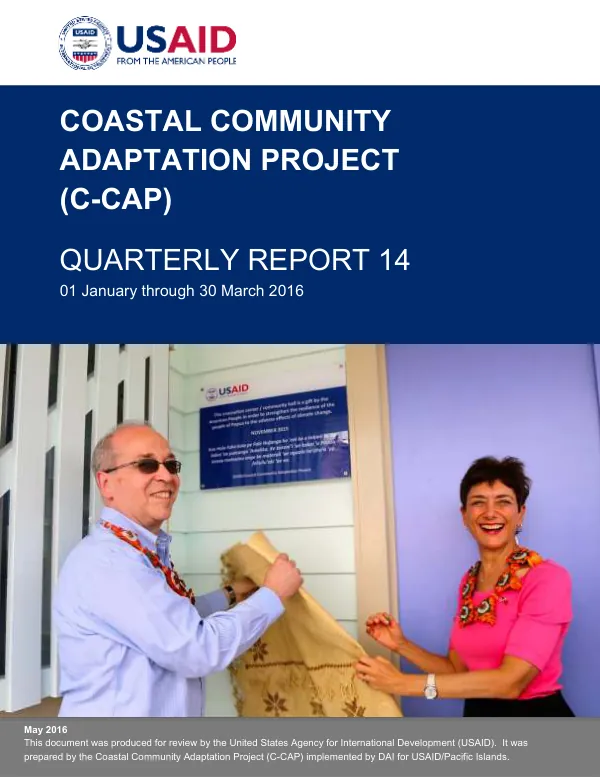
Coastal Community Adaptation Project (C-CAP) Quarterly Report 14
Open record 2015
2015USAID DEC