MINISTRY OF AGRICULTURE AND FISHERIES
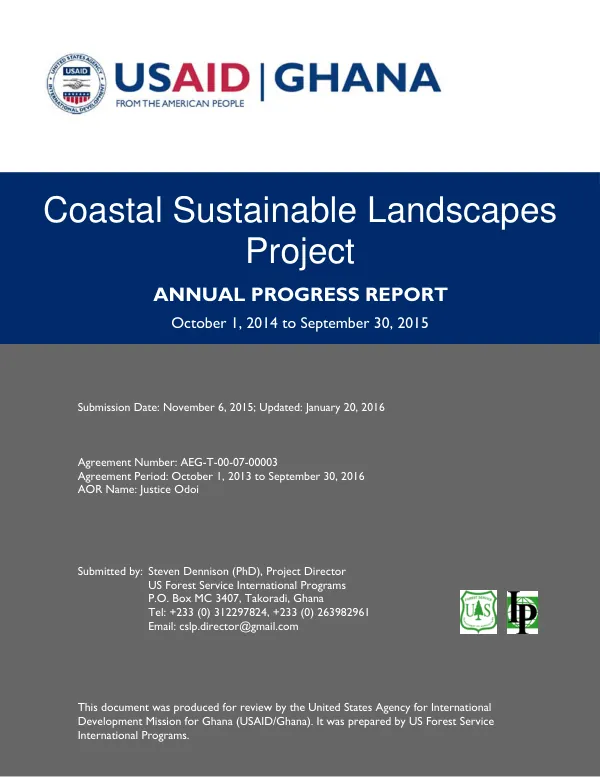
Coastal Sustainable Landscapes Project Annual Progress Report FY 2015
The Coastal Sustainable Landscapes Project (CSLP) operates in the six coastal districts of Ghana's Western Region, a rapidly growing area with significant land use pressures.
2015 · 37 pages
Sign in to readA free account is required to download.
Abstract
The region's forests are threatened by deforestation, conversion to agriculture, and urban development, exacerbated by high unemployment rates and a warming climate. Climate change poses risks to the landscape, including increased temperatures, irregular weather patterns, and rising sea levels. The project aims to improve carbon sequestration, forest management, and livelihoods in the six coastal districts. The overall long-term impact of the project is to promote low emissions development in Ghana's Western Region by strengthening community-based natural resource management and monitoring. The project focuses on the coastal landscape, including mangroves, other wetlands, and forests and agricultural areas, all of which are managed under a diversity of land tenure regimes. The CSLP strategy involves community-level interactions to achieve low emissions development goals. One key component is the application of a Village Savings and Loan Association (VSLA) model, a social entrepreneurial concept that has already enjoyed success in Ghana. The project employs the VSLA model as a novel vehicle to encourage and promote activities that maintain and increase forest cover with native and existing tree species. In FY 2015, the project achieved several key milestones. A total of 1,947 local farmers were trained in climate smart agriculture, beekeeping, and forestry/agroforestry livelihood options. The trainees adopted best farming practices promulgated in these modules. Additionally, 269 farmers were trained in beekeeping as a diversified livelihood option, and six local artisans were trained in beehive construction, enhancing their income sources. Four community tree nurseries were established and supplied with equipment to produce over 26,000 seedlings for planting. A total of 44,000 seedlings were distributed for planting, and an additional 10,000 mangrove seedlings were raised and are ready for planting in FY 2016. Ten new Village Savings and Loan Associations (VSLAs) were established and are functioning, and 17 Village Agents were trained to support the VSLAs across the six coastal districts. The project also organized several climate change trainings for stakeholders, a media day involving Western Region Coordinating Council stakeholders, and community climate change awareness sessions that included nighttime video viewings and discussions about local climate change events and adaptation. Stakeholders' briefings were organized for traditional authorities, district assembly staff, CREMAs, etc. Finally, 30 Community Assistants were trained to use GPS units facilitating land use and land cover (LULC) farm mapping and tree nursery management. The project's activities are being established within communities where there is an existing and functioning community governance body, such as Community Resource Management Areas (CREMAs) or similar entities. This history of community collaboration provides an entry point to develop a community's capacity to launch their own VSLA and oversee loans to community members. The project's efforts will contribute to increased employment, improved livelihoods, better land management of existing natural resources, increased soil fertility, and increased carbon stocks.
Related documents