CHEMONICS
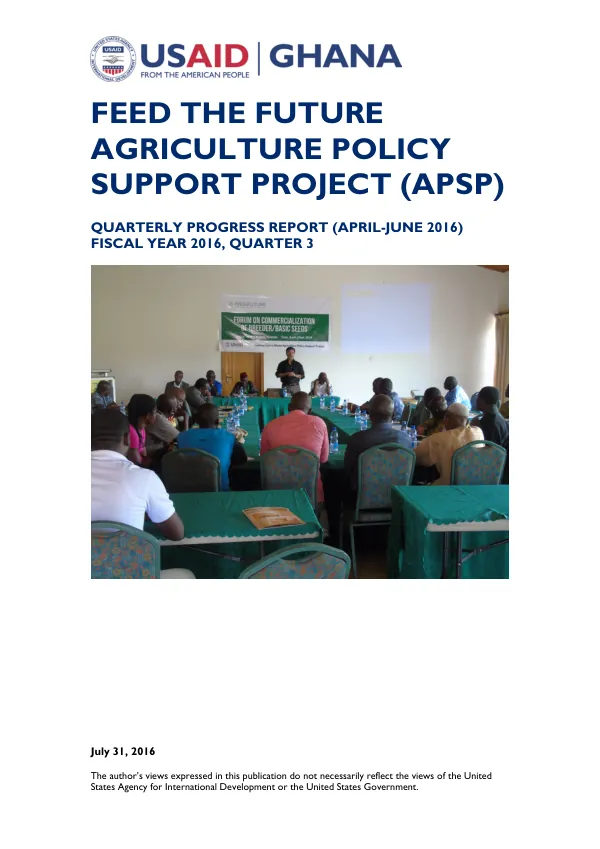
Agriculture Policy Support Project Quarterly Report (April-June 2016)
The Feed the Future Agriculture Policy Support Project (APSP) aims to improve the food security enabling environment for private sector investment in Ghana.
2016 · 145 pages
Sign in to readA free account is required to download.
Abstract
The project has three components: policy formation and implementation, policy research, and policy advocacy. The main goal is to increase the capacity of the Government of Ghana, the private sector, and civil society organizations to implement evidence-based policy formation and implementation, research and advocacy, and rigorous monitoring and evaluation of agricultural programs. Component 1, policy formation and implementation, focuses on improving Ghana's agricultural sector policy process for evidence-based decision making related to food security. During the third quarter, APSP achieved several major accomplishments. The Ministry of Food and Agriculture's (MoFA) ability to carry out evidence-based policy analysis and advice was improved by working with officials to strengthen and restructure its Policy Unit. This included creating and adopting a new organogram and job descriptions for Policy Unit staff, as well as providing rigorous training on policy analysis to 14 MoFA staff. APSP also provided consultation to the MoFA to draft and finalize its Annual Performance Review (APR), which documents sector progress in achieving Medium Term Agriculture Sector Investment Plan (METASIP) targets and objectives. The APR will form the basis for the August 2016 Joint Sector Review (JSR) and support the creation of a platform for public and private sector stakeholders and development partners to evaluate sector performance and strategize for the future. In addition, APSP strengthened the enabling environment for private sector investment in agricultural land by assisting the Government of Ghana in formulating and validating groundbreaking land policy guidelines and an updated Land Bill. This support is critical for the Government's first attempt to regulate the acquisition of large tracts of land and improve land administration by introducing transparency, defining standard procedures for acquisitions, and creating mechanisms for community involvement. APSP also facilitated community input and validation of an APSP-developed farmer-based organization (FBO) strategy paper. The strategy paper advances existing Government of Ghana efforts to revitalize sector growth by recommending important reforms to strengthen and improve operational efficiencies within FBOs and enable them to provide better agricultural extension services to their members. Furthermore, APSP advanced its policy assessment program through three major policy assessments, which is paving the way for more effective policy analysis and decision making in the agricultural sector. These accomplishments demonstrate the project's progress in improving the food security enabling environment for private sector investment in Ghana. The project's policy research component aims to increase rigorous policy analysis capacity for evidence-based policy making. During the third quarter, APSP continued to implement its work plan and achieved several major accomplishments. The project provided technical assistance to the Ministry of Food and Agriculture to conduct a policy research study on the impact of agricultural extension services on farmer productivity and income. APSP also supported the development of a policy brief on the role of women in agricultural development, which highlights the importance of addressing the needs and challenges of women farmers in Ghana. The policy brief provides recommendations for policy makers and development partners to support the empowerment of women in agriculture. In addition, APSP facilitated a policy dialogue on the role of private sector investment in agricultural development, which brought together stakeholders from the public and private sectors to discuss the opportunities and challenges of private sector investment in agriculture. The policy dialogue provided a platform for stakeholders to share their experiences and perspectives on the role of private sector investment in agricultural development. The project's policy advocacy component aims to strengthen the institutional and technical capacities of private agribusiness organizations, civil society organizations, and the media to enable them to increase their participation and amplify their voices in the public policy process. During the third quarter, APSP continued to implement its work plan and achieved several major accomplishments. APSP provided technical assistance to the Ghana Chamber of Commerce and Industry to develop a policy brief on the role of private sector investment in agricultural development. The policy brief highlights the importance of private sector investment in agricultural development and provides recommendations for policy makers and development partners to support the growth of the private sector in agriculture. APSP also supported the development of a media campaign to raise awareness about the importance of agricultural development in Ghana. The media campaign included a series of articles and editorials in major newspapers and magazines, as well as a series of radio and television programs on agricultural development. In addition, APSP facilitated a policy dialogue on the role of civil society organizations in agricultural development, which brought together stakeholders from civil society organizations to discuss the opportunities and challenges of civil society organizations in agricultural development. The policy dialogue provided a platform for stakeholders to share their experiences and perspectives on the role of civil society organizations in agricultural development. Overall, the APSP project has made significant progress in improving the food security enabling environment for private sector investment in Ghana. The project's accomplishments demonstrate its commitment to increasing the capacity of the Government of Ghana, the private sector, and civil society organizations to implement evidence-based policy formation and implementation, research and advocacy, and rigorous monitoring and evaluation of agricultural programs.