THE WORLD RESOURCES INSTITUTE
Greenhouse Gas Emissions by Sector in Ghana
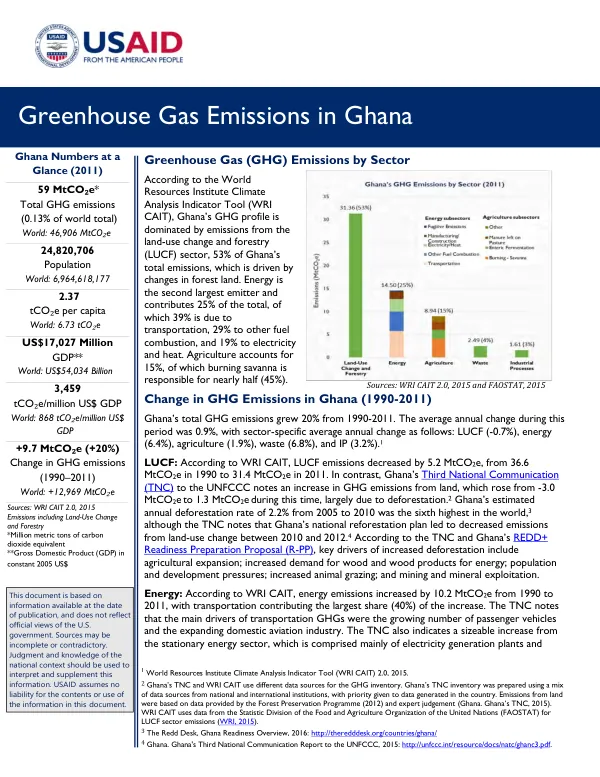
Ghana's Greenhouse Gas (GHG) Emissions Profile is dominated by the land-use change and forestry (LUCF) sector, accounting for 53% of the country's total emissions.
2016 · 2 pages
Sign in to readA free account is required to download.
Abstract
This sector is driven by changes in forest land, with emissions decreasing by 5.2 MtCO2e from 36.6 MtCO2e in 1990 to 31.4 MtCO2e in 2011, according to the World Resources Institute Climate Analysis Indicator Tool (WRI CAIT). However, Ghana's Third National Communication (TNC) to the UNFCCC notes an increase in GHG emissions from land, which rose from -3.0 MtCO2e to 1.3 MtCO2e during this time, largely due to deforestation. The energy sector is the second largest emitter, contributing 25% of Ghana's total emissions. Transportation is the largest share of energy emissions, accounting for 40% of the increase from 1990 to 2011. The main drivers of transportation GHGs were the growing number of passenger vehicles and the expanding domestic aviation industry. The energy sector also saw an increase in electricity consumption due to rising demand from electrified households, expanding commercial activities, and larger household incomes. Agriculture accounts for 15% of Ghana's total emissions, with burning savanna responsible for nearly half (45%) of these emissions. The agriculture sector grew 32% from 1990-2011, with the rise in the number of livestock and frequent burning of biomass through land clearing contributing to the increase in emissions. Between 1999 and 2010, the livestock sector grew 177%. Ghana's GHG emissions grew 20% from 1990-2011, with the average annual change during this period being 0.9%. The carbon intensity of Ghana's economy is almost 4 times the world average, indicating potential for reducing GHG emissions relative to GDP. Ghana aims to reduce GHG emissions 15% by 2030 compared to the Business as Usual (BAU) scenario through actions including a 20% improvement in energy efficiency of industrial facilities, replacement of light crude oil with natural gas in electricity generation plants, and the reforestation and afforestation of 10,000 hectares of degraded lands annually. Ghana's Intended Nationally Determined Contribution (INDC) identifies emission reduction actions to be undertaken between 2020 and 2030 in the energy, transportation, agriculture, forestry and land use, waste, and industry sectors. The INDC notes that this target could be strengthened to 45% with international support by increasing renewable energy penetration, scaling up adoption of efficient cookstoves, expanding mass transportation in cities, and improving forest and solid waste management.
Related documents