BANK FOR WEST AFRICAN DEVELOPMENT
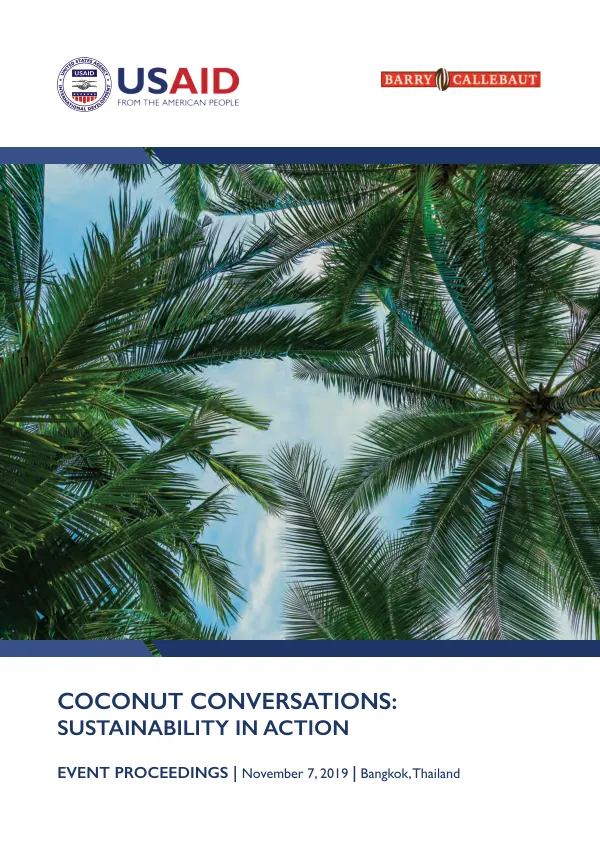
Coconut Conversations: Sustainability in Action
The coconut industry faces a crisis due to record global demand and a supply chain threatened by underperforming senile trees, escalating natural disasters, and farmers' lack of technical, market, and financial access.
2019 · 11 pages
Sign in to readA free account is required to download.
Abstract
The industry's estimated $31 billion dollar value is at stake, spanning cosmetics to confectionary goods. Siloed approaches to addressing the supply shortfall fail to account for interconnected, complex, overlapping supply chains and will be ineffective to boost reliable supply. Industry leaders agreed on broad areas of improvement for the coconut industry at the inaugural Sustainable Coconut and Coconut Oil Roundtable in March 2019. These areas include farmers' livelihoods and income, supply of productive coconut trees, farmers' productivity, traceability, deforestation prevention, and farmers' access to technology. Participants expressed interest in advancing pre-competitive collaboration on an industry-wide "sustainable coconut charter" that will identify common goals, benchmarks, and outcomes for coconut sustainability programs. The charter incorporates five foundational principles: improving smallholder livelihoods and incomes, enhancing traceability, reducing deforestation, increasing access to technology, and replanting and replacing. A driving force behind the charter is to secure a supply of sustainably produced coconuts. Without pre-competitive industry collaboration to improve long-term coconut supply, ensuring cost-efficiency and economies of scale, higher yield, improved quality, and secure coconut supply are difficult, if not impossible. Barry Callebaut and USAID Green Invest Asia will organize multi-stakeholder feedback sessions on an industry-wide charter in preparation for a March 2020 consultation. The goal is to secure as many endorsements from industry players and relevant stakeholders in the coconut industry as possible to create a pre-competitive, positive movement that drives supply chain improvements. Industry players and stakeholders emphasized the need for collective action to address the supply shortfall. Angela Hogg, Regional Environmental Officer at USAID Asia, noted that no single government, company, or donor has the answer to meeting the double-digit rising demand for coconut water, sugar, and oil. Christy Owen, Chief of Party at USAID Green Invest Asia, stated that it's time to share budget to improve sourcing locations and mainstream sustainability efforts with industry standards and collaborate. The industry-wide charter aims to rally the industry around common goals, harmonize sustainability efforts and requirements of different company supply chains, and benchmark sustainability schemes. The charter's five foundational principles are designed to improve livelihoods and incomes for smallholder coconut farmers and their communities, which is a central goal.