TECHNOSERVE, INC.
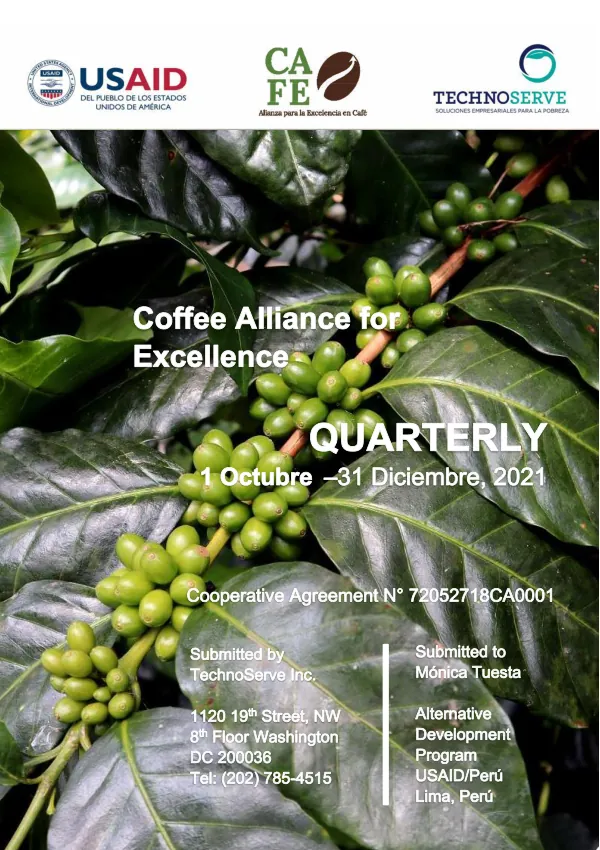
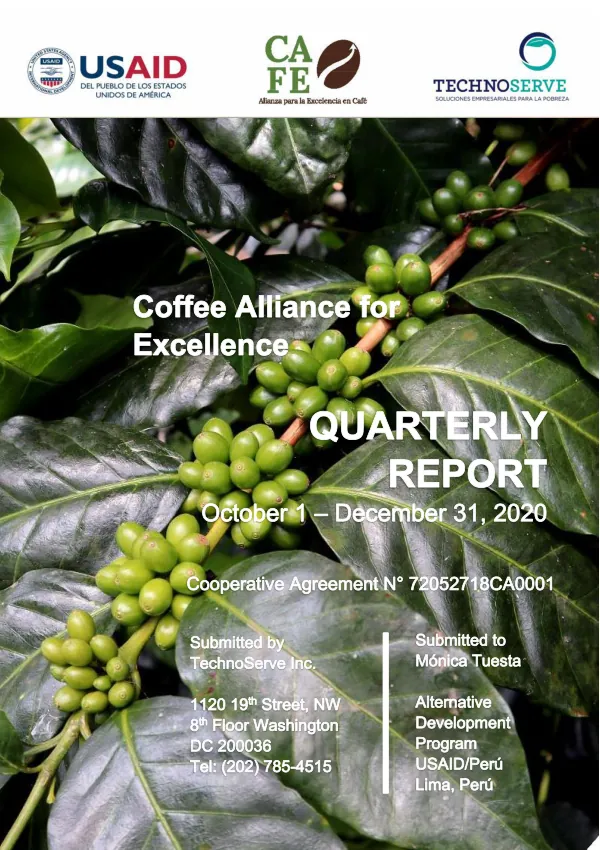
Coffee Alliance for Excellence: Cooperative Agreement N. 72052718CA00001
The Coffee Alliance for Excellence is a cooperative agreement between TechnoServe, Inc.
2020 · 49 pages
Sign in to readA free account is required to download.
Abstract
and USAID/Peru's Alternative Development Program. The agreement, numbered 72052718CA00001, was submitted by TechnoServe, Inc. and covers the period from November 2017 to October 2022. The total funding for the project is $11,225,896, with $7,988,550 allocated for the period from October 1 to December 31, 2020. The project's main objective is to improve the livelihoods of coffee producers in Peru through sustainable production practices, market access, and financial inclusion. The project focuses on three main components: Producers Increase Sustainable Production Practices, Producers Strengthen Access to Markets, and Producers Improve Access to Formal Financial Markets. Under the first component, 7,811 producers, including 25% women, were trained in integrated pest management, safe use of pesticides, soil conservation, and farm management. The producers implemented 528 environmental measures, mainly related to pesticide use, solid waste treatment, and pulp management. The project also supported the certification process for 1,856 producers, resulting in the commercialization of 282,027 kg of specialty coffees scoring 83 points and above on the 100-point Coffee cupping scale. In the market access component, the project strengthened the Business Producer Groups (PBGs) by providing individual consultancies to their boards of directors. The PBGs identified positive aspects and areas for improvement in their marketing processes, allowing them to strengthen their commercial relations with OLAM and PERHUSA. The project also continued the certification process for 1,856 producers, resulting in the commercialization of 282,027 kg of specialty coffees. In the financial inclusion component, the project worked with Caja Rural Los Andes and Cooperativa Nor Andino to place $1,840,419 in loans benefiting 510 producers and 2 organizations. The project also provided advisory services to the members of the boards of directors of the UNICAs, aiming to turn towards individual attention to the members of these groups. The project also supported income diversification by providing consulting services to 16 entrepreneurs, resulting in 5 ventures generating sales of $19,336. The project also supported the packaging design and trademark application process for 7 enterprises, allowing them to position their products at a regional and national level. The project mainstreamed the gender approach in all its activities, aiming to empower women throughout the coffee value chain. The activities focused on family counseling, assisting 276 families, and counseling 209 managers from 46 PBGs, in order to strengthen the role of female members in their organizations. The project also completed the hiring of the team of community trainers, with a total of 55 people in the field. The team assisted 3,541 producers in the modules of integrated pest management and safe use of pesticides, soil conservation, and farm management. The project also assisted 4,495 producers out of a total of 7,811, with group training expected to resume during the second quarter of fiscal year 2021. The project also supported the International Potato Center's work on remote sensing of nutritional deficiencies using aerial images obtained with a drone and sensors. The project proposed to transfer the drones, cameras, and software acquired and developed under this sub-award to the Institute of Development of Ceja de Selva de la National University Toribio Rodríguez de Mendoza. The project also presented the final report of the Mid-Term Evaluation, which highlighted the satisfaction of the producers to the Coffee Farm College trainings (93%), who expressed satisfaction with the presence of the community trainers in their plots. The report also recognized the recognition of women assisted by gender activities (97%), who mentioned that family relationships and distribution of roles have greatly improved after the training received. The report also identified the need to review the assumptions of the Theory of Change that are not being fulfilled and are affecting the achievement of certain indicators.
Related documents