USAID DEC
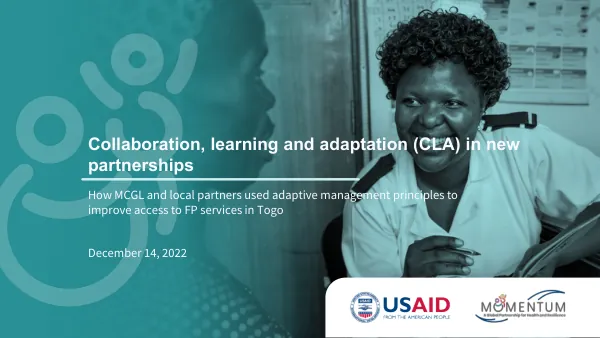
Collaboration, learning and adaptation (CLA) in new partnerships: How MCGL and local partners used adaptive management principles to improve access to FP services in Togo
Sign inUSAID DEC
Collaboration, learning and adaptation (CLA) in new partnerships: How MCGL and local partners used adaptive management principles to improve access to FP services in Togo
The Momentum Country & Global Leadership (MCGL) initiative in Togo aimed to improve access to and use of quality reproductive health and family planning (RH/FP) services in the Ogou and Golfe districts.
2022 · 60 pages
Sign in to readA free account is required to download.
Abstract
The initiative's objectives included strengthening communication amongst couples on health/FPAC issues, strengthening the commitment and capacity of civil society organizations (CSOs) to support FP services, and improving access to quality RH/FP services. The MCGL initiative collaborated with local partners, including FAMME, SOS-Vita, CORE, EVT, and ATPDC, to achieve its objectives. These partners implemented various interventions, including community discussions, impulse surveys with providers, and adapted workplans informed by behavioral profiles. The initiative's learning program focused on men's engagement in FP/RH care and MNCH/FNC services, with the goal of understanding how men can be engaged in couple communication activities at the community level without compromising women's rights and autonomy. The initiative used adaptive management principles to improve access to FP services in Togo. This approach involved co-creation of work plans and development of behavioral profiles to inform the implementation of interventions. The initiative also established coordination committees in the Ogou and Golfe districts to facilitate collaboration and coordination among partners. The MCGL initiative in Togo employed various strategies to engage men in FP/RH care and MNCH/FNC services. These strategies included offering support with side effect management, promoting fair decision-making, and encouraging mutual trust between couples. The initiative also recognized the importance of addressing barriers to men's involvement, such as lack of correct information on methods, rumors, and tradition of having a big family. The initiative's learning program identified several key factors that influence men's engagement in FP, including gender, knowledge, attitudes/beliefs, and social norms. The program also developed behavioral profiles to inform the implementation of interventions, including profiles for couples, adolescents and youth in intimate relationships, and community discussions. The MCGL initiative in Togo demonstrated the effectiveness of adaptive management principles in improving access to FP services. The initiative's use of co-creation of work plans, behavioral profiles, and coordination committees facilitated collaboration and coordination among partners, ultimately leading to improved outcomes. The initiative's focus on men's engagement in FP/RH care and MNCH/FNC services also contributed to its success, as it helped to address the needs of men and couples as clients while promoting positive health outcomes without compromising women's rights and autonomy.
Related documents