USAID DEC
Integrating Health and Family Planning into Greater Amanzule Wetland Landscape Conservation and Small Scale Fisheries Management in the Western Region of Ghana
Sign inFHI 360
Integrating Health and Family Planning into Greater Amanzule Wetland Landscape Conservation and Small Scale Fisheries Management in the Western Region of Ghana
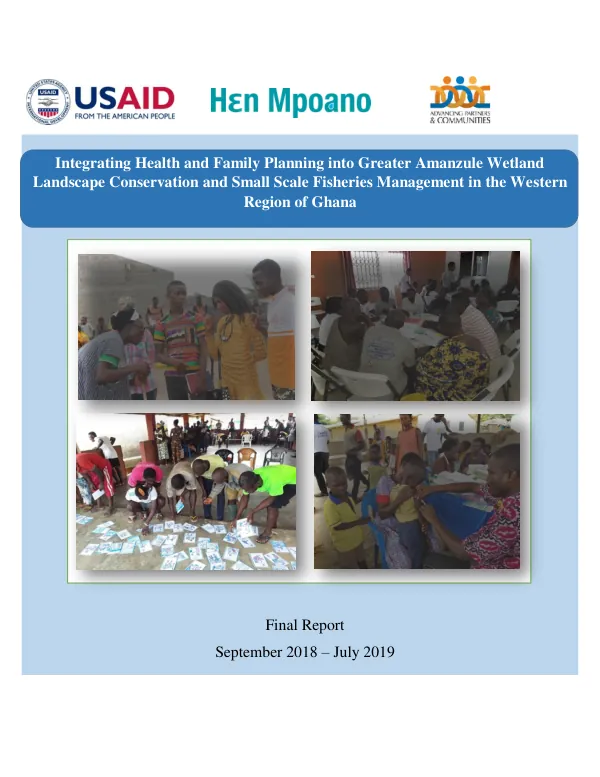
The Integrating Health and Family Planning into Greater Amanzule Wetland Landscape Conservation and Small Scale Fisheries Management in the Western Region of Ghana project aimed to promote population health and environment (PHE) approaches in the Western Region of Ghana.
2019 · 40 pages
Sign in to readA free account is required to download.
Abstract
The project was implemented from October 2018 to August 2019 by Hen Mpoano, in collaboration with Advancing Partners and Communities (APC), a cooperative agreement funded by the U.S. Agency for International Development. The project focused on four objectives: creating awareness and interest for PHE approaches, promoting access to health, environment, and livelihood using PHE platforms, strengthening institutional collaboration across sectors, and designing and implementing a learning agenda for PHE integration. To achieve these objectives, the project implemented various activities, including interactive drama sessions, validation workshops, training workshops, and the mobilization of PHE champions for radio sensitization and awareness creation. The project also developed and disseminated information, education, and communication (IEC) materials, including posters and story cards, to promote PHE approaches among the target communities. Additionally, the project organized networking meetings for PHE champions and peer educators to share experiences and best practices. The project's outreach activities aimed to promote access to health, environment, and livelihood using PHE platforms. The activities included the selection of PHE champions and peer educators, the assessment of existing community distribution systems for contraceptives, and the organization of networking meetings for PHE champions and peer educators. The project also aimed to strengthen institutional collaboration across sectors to build support for future PHE initiatives. To achieve this objective, the project implemented PHE outreach activities, which included the planning and implementation of outreach activities, the collection of outcomes and comments from community members, and the organization of a project close-out workshop to disseminate key lessons. The project's learning agenda focused on designing and implementing a scorecard system to monitor and evaluate PHE project progress. The scorecard system was used to assess the effectiveness of the project's activities and to identify areas for improvement. The project also implemented a family planning client referral monitoring system and integrated family planning into Village Savings and Loans Association (VSLA) activities. The project faced several challenges, including the need for more resources to support the project's activities and the need for more effective communication between the project team and the target communities. Despite these challenges, the project made significant progress in promoting PHE approaches and improving access to health, environment, and livelihood in the Western Region of Ghana. The project's outcomes included the creation of awareness and interest for PHE approaches among the target communities, the promotion of access to health, environment, and livelihood using PHE platforms, and the strengthening of institutional collaboration across sectors. The project's lessons learned document provides a detailed account of the project's activities, outcomes, and challenges, and serves as a valuable resource for future PHE initiatives in the Western Region of Ghana.
Related documents