USAID DEC
Collective Action in the Irrigation Sector of Uzbekistan: A Case Study of Water Consumers’ Associations (WCAs) in the Karshi Steppe
Sign inUSAID
Collective Action in the Irrigation Sector of Uzbekistan: A Case Study of Water Consumers’ Associations (WCAs) in the Karshi Steppe
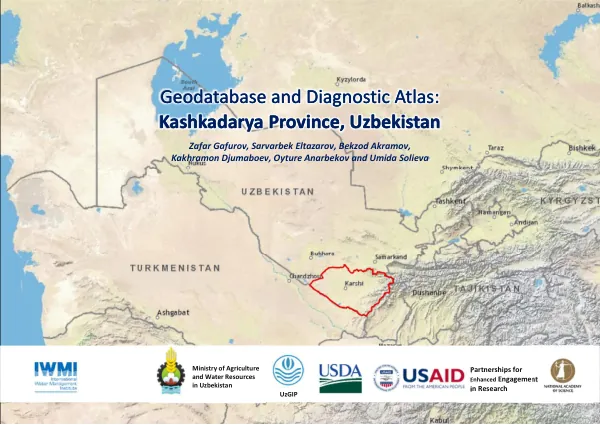
Kashkadarya Province plays an important role in the economy of the Republic of Uzbekistan, producing natural gas, agricultural products, and raw materials for construction.
2018 · 40 pages
Sign in to readA free account is required to download.
Abstract
Approximately 75% of the water is supplied by the Amudarya River through a cascade of pumping stations, with the remaining 25% coming from the Zarafshan River, Eskianhor canal, and other internal rivers. Prior to the Soviet occupation, the local population primarily engaged in cultivating grain crops and some gardening. The Ministry of Land Reclamation and Water Resources of the USSR became involved in the expansion of irrigated areas in the late 1920s and early 1930s, focusing on more effective use of machinery and the engineering or rebuilding of different types of irrigation systems. As a result, the irrigated land in the province increased from 63,000 hectares in 1915 to 514,000 hectares in 2010. This increase was due to a gigantic Soviet hydraulic program through the construction of dams, irrigation canals, pumping stations, and various hydraulic facilities, particularly the Mega project – Karshi Steppe Reclamation Program. The Karshi Steppe is characterized by harsh climatic conditions with frequent water shortages. The process of agricultural water sector reform began with Decree No.320 of the Cabinet Ministries of Uzbekistan in July 21, 2003, "Improvement in the Organization of Water Resources Management." A key element of the reform was to create a two-level system for managing waters – the establishment of Basin Irrigation System Authority (BISA) and the creation of Water Consumers' Associations (WCAs). The Department of Water Resources was established in the Ministry of Agriculture and Water Resources (MAWR) to manage water resources in the country. Under it, 10 BISAs were established, and under each BISA, irrigation system authorities (ISAs) were set up. There are several ISAs in each province and each basin, and there are altogether 63 ISAs. In place of the previous Kashkadarya Provincial Water Department, which had managed water resources in accordance with the territorial principles, Amu-Kashkadarya BISA was established in 2003 to manage water resources based on the hydrographic (basin) principles. The study focuses on the Karshi Steppe, a region characterized by harsh climatic conditions with frequent water shortages. The Karshi Steppe Reclamation Program was a key component of the Soviet hydraulic program, which aimed to increase irrigated land in the province. The program involved the construction of dams, irrigation canals, pumping stations, and various hydraulic facilities. The irrigated land in the province increased from 63,000 hectares in 1915 to 514,000 hectares in 2010. The study aims to investigate the effectiveness of Water Consumers' Associations (WCAs) in managing water resources in the Karshi Steppe. WCAs are a key component of the two-level system for managing waters, established by the government in 2003. The study will examine the characteristics of selected WCAs, including their organizational structure, management practices, and water use efficiency. The study will also identify the main challenges faced by WCAs in the Karshi Steppe and potential causes for these problems. The study will use a case study approach, focusing on two WCAs in the Karshi Steppe: Muglon Obi Hayoti WCA and Chashmai Mirob WCA. The study will collect data through focus group discussions (FGDs) and expert interviews with WCA members, officials, and other stakeholders. The study will also analyze data on water use efficiency, crop yields, and other relevant indicators. The study's findings will provide insights into the effectiveness of WCAs in managing water resources in the Karshi Steppe. The study will identify best practices and areas for improvement, which can inform policy and decision-making at the national and local levels. The study's recommendations will aim to improve water use efficiency, reduce water waste, and promote sustainable agriculture practices in the Karshi Steppe.