USAID DEC
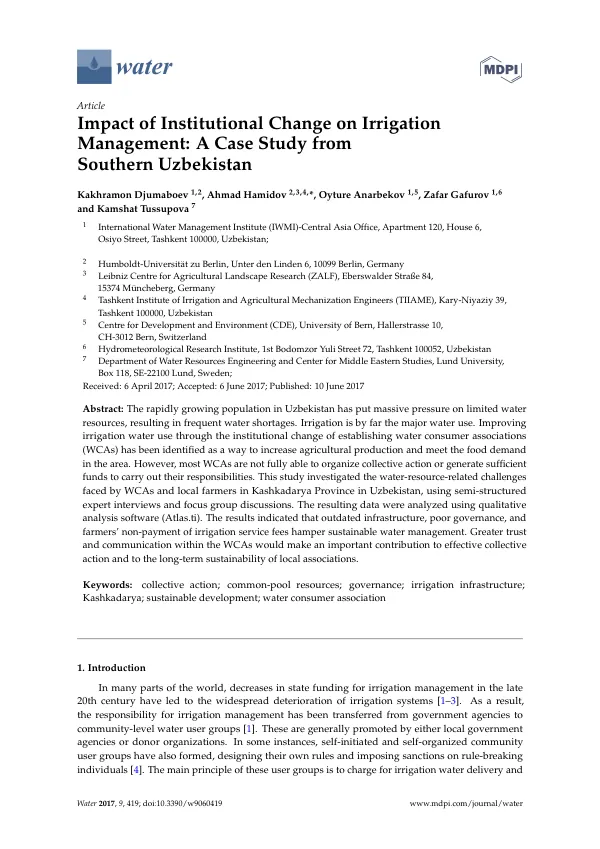
Impact of Institutional Change on Irrigation Management: A Case Study from Southern Uzbekistan
Sign inBANK FOR WEST AFRICAN DEVELOPMENT
Impact of Institutional Change on Irrigation Management: A Case Study from Southern Uzbekistan
Institutional change through the establishment of water consumer associations (WCAs) has been identified as a means to improve irrigation water use and increase agricultural production in Uzbekistan.
2017 · 18 pages
Sign in to readA free account is required to download.
Abstract
The country's rapidly growing population has put massive pressure on limited water resources, leading to frequent water shortages and deterioration of water quality. Irrigation is the primary water use, accounting for the majority of the country's water consumption. The introduction of WCAs aims to improve water management through collective action and collective action is essential for effective management of common-pool resources (CPRs). However, most WCAs in Uzbekistan have struggled to ensure timely water delivery and generate sufficient funding to sustain their operations. This has led to weak management and governance structures, which are limitations associated with top-down approaches to collective action. The study focuses on the Khashkadarya Province, where the water management efforts of WCAs and farmers are assessed. The research aims to identify the factors that contribute to effective cooperation in CPR management and to offer recommendations for improved water management at the WCA level. The study is based on the assumption that when a resource generated from a CPR is valued and the users benefit from appropriating it under locally designed rules, effective cooperation in CPR management is likely to occur. Uzbekistan's irrigation reforms aim to improve water use and reduce water scarcity. The country's population growth has put pressure on its limited water resources, leading to water scarcity and deterioration of water quality. The management of water resources in the Aral Sea Basin is a complex process, complicated by the rising demand for energy and food, environmental degradation, and increased pressure on the region's finite water resources due to economic development, population growth, and climate change. Improving water use through the introduction of low-cost water-saving technologies and the upgrade of on-farm irrigation systems has been identified as a means to reduce water demand and improve water quality. The study highlights the importance of communication and active involvement of resource users in decisions about managing and maintaining the CPR, as well as the need for effective cooperation in CPR management. The research aims to contribute to the development of effective governance systems for WCAs in Uzbekistan, which is essential for improving water management and reducing water scarcity. The study's findings are expected to inform policy and decision-making at the national and local levels, with the goal of promoting sustainable development and improving the lives of people in Uzbekistan. The study's methodology involves semi-structured interviews and focus group discussions with WCAs and farmers in the Khashkadarya Province. The data collected will be analyzed using qualitative analysis software to identify the factors that contribute to effective cooperation in CPR management and to offer recommendations for improved water management at the WCA level. The study's focus on the Khashkadarya Province provides a unique opportunity to assess the water management efforts of WCAs and farmers in a specific region. The study's findings are expected to contribute to the development of effective governance systems for WCAs in Uzbekistan, which is essential for improving water management and reducing water scarcity.