USAID DEC
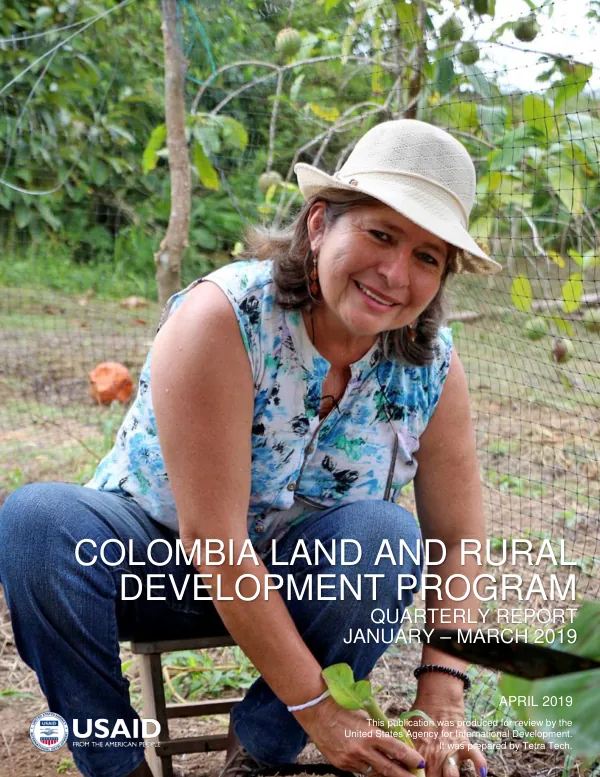
Colombia Land and Rural Development Program: Quarterly Report (January – March 2019)
Sign inGOVERNMENT OF COLOMBIA
Colombia Land and Rural Development Program: Quarterly Report (January – March 2019)
The Land and Rural Development Program (LRDP) in Colombia is a five-year task order under the Strengthening Tenure and Resource Rights Indefinite Quantity Contract.
2019 · 52 pages
Sign in to readA free account is required to download.
Abstract
The program began in July 2013 and was granted an extension in March 2018. The main objective of LRDP is to accelerate the completion of the Ovejas pilot and make it visible to the highest levels of the government of Colombia. During the quarter, LRDP's main objective was to accelerate the completion of the Ovejas pilot. To achieve this, LRDP made the pilot visible to the highest levels of the government of Colombia, including the Office of the Presidency and other high-level officials. LRDP participated in several meetings with the Presidential Senior Advisor for Compliance, where they successfully communicated the importance of completing the pilot. As a result, the Office of the Presidency placed pressure on the National Land Agency and IGAC to proceed with their final steps of the pilot. LRDP also delivered a set of recommendations to Carlos Enrique Moreno, the Presidential Senior Advisor for Compliance, who then submitted these ideas within a broader package of strategic recommendations to the High Council for the Administration of Rural Land. The council will now issue an official policy directive instructing institutions to undertake specific operational and procedural changes in order to facilitate the country's new approach to updating its cadaster. Despite the high-level commitment to the pilot, the National Land Agency and IGAC continued to demonstrate a lack of operational and managerial capacity to carry out the tasks assigned to them. LRDP will continue to conduct strategic advocacy around the pilot, share their observations with high-level officials, and support their counterparts to ensure that residents of Ovejas receive the property rights they deserve. Key advances during the quarter include the Ovejas pilot producing a 60% reduction in the cost of land formalization. However, a host of barriers outside of LRDP's control continue to push the pilot's timeline back even further. The Land Node received its first international award, the u-GOB prize from Mexico, in light of its technological promise for citizens. The Rural Development Agency launched an online tool for public-private partnerships, which LRDP supported the design and layout of. As of March 2019, the Land Node had facilitated more than 2 million real-time digital transactions in support of land restitution. The Land Node, whose design and implementation was spearheaded by LRDP in collaboration with the Land Restitution Unit, received an international award in March. LRDP's efforts have contributed to the country's new approach to updating its cadaster, making the process more efficient, transparent, and streamlined. LRDP's work has also focused on supporting the design and implementation of the Land Node, a digital platform that makes the country's restitution process more secure and efficient. The platform has facilitated digital transactions, reducing the need for paper-based processes. LRDP has also supported the design and layout of an online tool for public-private partnerships, which aims to bring farmers closer to end markets. The LRDP has been working closely with government counterparts, including the National Land Agency and IGAC, to support the completion of the Ovejas pilot. Despite the challenges faced by these entities, LRDP will continue to conduct strategic advocacy and support their counterparts to ensure that the pilot is completed and the residents of Ovejas receive the property rights they deserve. The LRDP has made significant progress in its efforts to support the government of Colombia in its land and rural development initiatives. The program's work has contributed to the country's new approach to updating its cadaster, making the process more efficient, transparent, and streamlined. LRDP's efforts have also focused on supporting the design and implementation of the Land Node, a digital platform that makes the country's restitution process more secure and efficient.