GOVERNMENT OF COLOMBIA
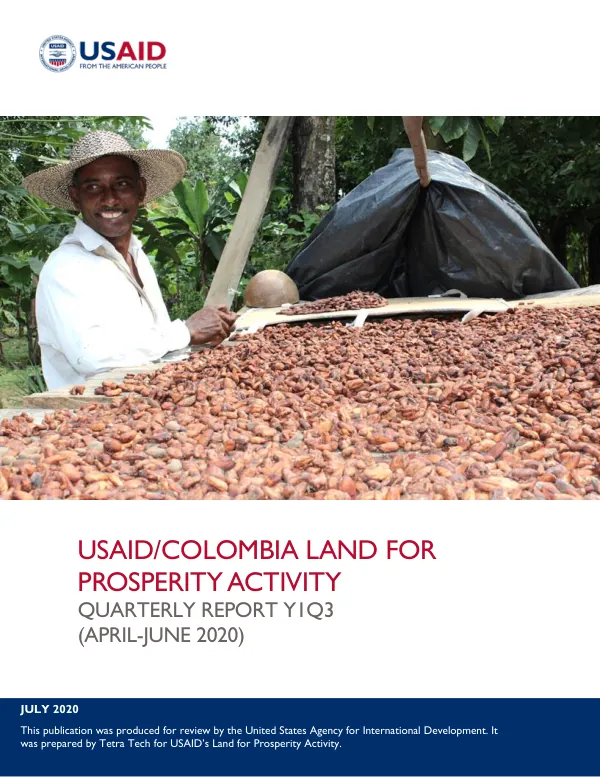
Land for Prosperity Activity: Quarterly Report (October – December 2019)
The Land for Prosperity Activity is a USAID-funded project aimed at contributing to peace and stability in Colombia by expanding licit livelihood options and reducing illicit crops.
2020 · 35 pages
Sign in to readA free account is required to download.
Abstract
The project will sustainably improve conditions of conflict-affected rural households through technical components, guiding principles, and enablers. The Activity adopted lessons learned and best practices from former USAID's Land and Rural Development Program, including the first parcel sweep methodology used to implement massive land formalization in Ovejas (Sucre). The project has made significant progress in its start-up phase, with the rapid engagement of critical Colombian staff and the establishment of operational infrastructure. By the end of the reporting period, the project had onboarded 33 full-time staff, secured permanent office space in Bogota, and established operating offices in Tolima and Montes de Maria. The team also submitted 10 contractual reporting deliverables, including the Year 1 Annual Work Plan, Activity Monitoring and Evaluation and Learning (AMEL) plan, and Communications and Outreach Plan. The project has also advanced high-level national and regional discussions necessary for implementation, including drafting a letter of intent to be signed by the Office of the Presidency and the Colombia Mission Director. The Activity has engaged with Presidential Counselors of Compliance, Stabilization, and Security, and national entities, including the National Land Agency (ANT), the Agency for Territorial Renovation (ART), and the Agency for Rural Development (ADR). The project has also participated in coordination sessions with different entities to support Territorial Economic Development Plans (PDETs) in some of Colombia's poorest and most conflict-affected regions. The project has selected ten municipalities for massive formalization pilots, including San Jacinto, El Carmen (Bolívar), Sardinata (Norte de Santander), Cáceres (Antioquia), Santander de Quilichao (Cauca), Tumaco (Nariño), Ataco, Chaparral (Tolima), Puerto Lleras, and Fuentedeoro (Meta). The project aims to support the Government of Colombia (GOC) in strengthening state presence in underattended regions, combating illicit economies, and supporting rural transformation. The project's approach is guided by the framework of technical components, guiding principles, and enablers. The technical components include land formalization, rural finance, and territorial development. The guiding principles include sustainability, scalability, and customization. The enablers include credible, scalable, customizable, and sustainable models that help the GOC strengthen state presence in underattended regions, combat illicit economies, and support rural transformation. The project's progress has been notable, with the quick approvals received for the contractual reporting deliverables. The Gender and Social Inclusion Analysis received notable praise from USAID. The project's high-level support has been secured, with the drafting of a letter of intent to be signed by the Office of the Presidency and the Colombia Mission Director. The project's engagement with national entities and coordination sessions with different entities has been successful, with the selection of ten municipalities for massive formalization pilots.