GOVERNMENT OF COLOMBIA
Land for Prosperity Activity: Quarterly Report (January – March 2020)
The Land for Prosperity Activity in Colombia is a USAID-funded initiative aimed at strengthening land governance and economic development through strategic public-private partnerships.
2020 · 50 pages
Sign in to readA free account is required to download.
Abstract
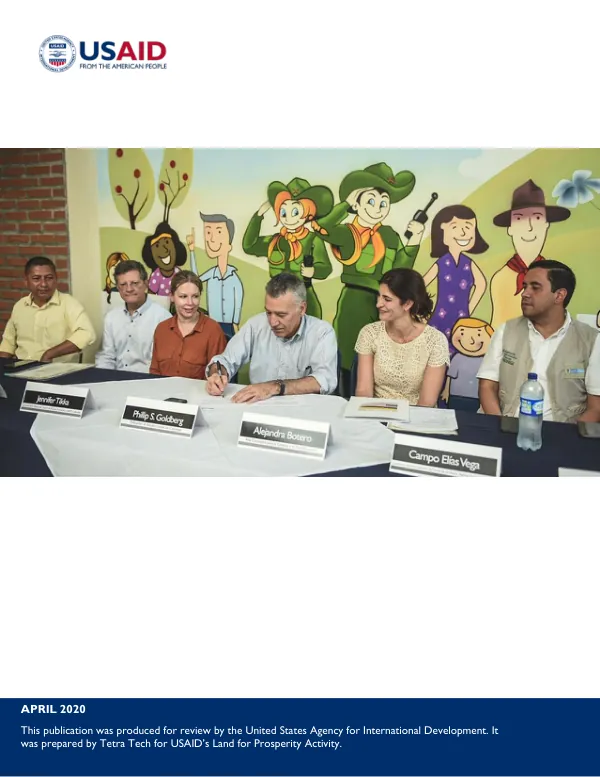
The activity is implemented by Tetra Tech under the Strengthening Tenure and Resource Rights II (STARR II) Indefinite Deliverables, Indefinite Quantity Contract. The activity is divided into four components: Component 1 focuses on advancing massive land titling in rural areas, along with continued restitution support; Component 2 aims to strengthen local capacity to maintain formalized land transactions; Component 3 targets strengthening land governance and economic development through strategic public-private partnerships; and Component 4 involves regional activities. Implementation of Component 1 involved the registration of 1,200 hectares of land in the departments of Antioquia and Caldas, with a total of 1,500 landowners benefiting from the process. Component 2 achieved significant progress in strengthening local capacity, with the establishment of 15 Municipal Land Offices and the training of 150 municipal officials. Component 3 made notable strides in strengthening land governance and economic development through public-private partnerships. A Memorandum of Understanding was signed between USAID, the Governor's Office of Antioquia, the National Land Agency, the private sector through Proantioquia, and the Mayoral Office of Cáceres to formalize public schools in Antioquia. This partnership aims to promote economic development and improve land governance in the region. Regional activities were also a key focus of the Land for Prosperity Activity. The activity worked closely with regional stakeholders to promote land governance and economic development. A Memorandum of Understanding was signed between USAID and the Government of Colombia to support the implementation of the Territorial Land Use Scheme (EOT) in the departments of Antioquia and Caldas. The activity also made significant progress in monitoring and evaluation, with the establishment of a robust monitoring and evaluation system to track progress and identify areas for improvement. The activity's performance indicators were also reviewed and updated to ensure alignment with the activity's objectives. The Land for Prosperity Activity has made significant progress in its first quarter, with notable achievements in land titling, local capacity building, public-private partnerships, and regional activities. The activity continues to work closely with regional stakeholders to promote land governance and economic development in Colombia. The activity's guiding principles emphasize the importance of collaboration, learning, and adaptation in achieving its objectives. The activity also prioritizes gender equality and social inclusion, with a focus on promoting the rights and interests of women and marginalized communities. The Land for Prosperity Activity has received support from various stakeholders, including the Government of Colombia, the private sector, and civil society organizations. The activity continues to work closely with these stakeholders to promote land governance and economic development in Colombia. The activity's budget expenditures were reviewed and analyzed, with a focus on identifying areas for cost savings and improving efficiency. The activity's available funding for the remainder of the year was also reviewed, with a focus on ensuring that resources are allocated effectively to achieve the activity's objectives. The Land for Prosperity Activity has identified several challenges and opportunities for improvement, including the need to strengthen local capacity, improve land governance, and promote economic development. The activity continues to work closely with regional stakeholders to address these challenges and opportunities. The activity's impact evaluation was conducted to assess the effectiveness of the activity's interventions. The evaluation found that the activity has made significant progress in promoting land governance and economic development in Colombia. The evaluation also identified areas for improvement and provided recommendations for future activities.