USAID DEC
Colombia's New Reincorporation Policy, Part I: International and National Historical Context
Sign inUSAID
Colombia's New Reincorporation Policy, Part I: International and National Historical Context
Colombia's new reincorporation policy, outlined in CONPES 3931, has been shaped by international and national experiences of Disarmament, Demobilization, and Reintegration (DDR).
2018 · 3 pages
Sign in to readA free account is required to download.
Abstract
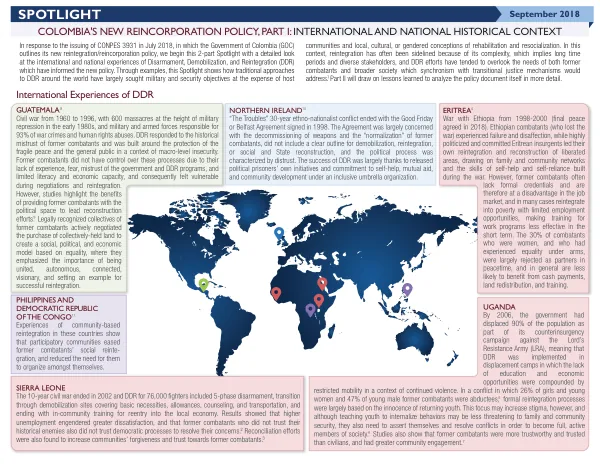
The policy aims to address the complexities of reintegration, which have often been overlooked in traditional DDR approaches. In Guatemala, the civil war from 1960 to 1996 resulted in 600 massacres and 93% of war crimes and human rights abuses attributed to the military and armed forces. DDR efforts focused on protecting the fragile peace and the general public, but former combatants lacked control over the process due to their limited experience, fear, and mistrust of the government and DDR programs. In Northern Ireland, the 30-year ethno-nationalist conflict ended with the Good Friday Agreement in 1998. The agreement did not include a clear outline for demobilization, reintegration, or social and State reconstruction, but the success of DDR was largely due to released political prisoners' own initiatives and commitment to self-help, mutual aid, and community development. In Uganda, the government's counterinsurgency campaign against the Lord's Resistance Army (LRA) displaced 90% of the population, and DDR was implemented in displacement camps. The lack of education and economic opportunities in these camps compounded the challenges of reintegration. Experiences of community-based reintegration in the Philippines and the Democratic Republic of the Congo show that participatory communities can ease former combatants' social reintegration and reduce the need for them to organize amongst themselves. In Sierra Leone, the 10-year civil war ended in 2002, and DDR for 76,000 fighters included a 5-phase disarmament, transition through demobilization sites, and ending with in-community training for reentry into the local economy. Results showed that higher unemployment engendered greater dissatisfaction, and that former combatants who did not trust their historical enemies also did not trust democratic processes to resolve their concerns. In Eritrea, the war with Ethiopia from 1998-2000 resulted in failure and disaffection among Ethiopian combatants, while highly politicized and committed Eritrean insurgents led their own reintegration and reconstruction of liberated areas. However, former combatants often lack formal credentials and are at a disadvantage in the job market, making training for work programs less effective in the short term. Colombia's national experience of DDR began in 1982-6, with the creation of the "Unconditional Amnesty in Favor of Peace Law (35)," which focused on amnesty at the expense of planning for former combatants' treatment beyond demobilization. The La Uribe contract and cease-fire were agreed in 1984, and the FARC formed the Unión Patriótica (UP) political party. However, a lack of security guarantees resulted in the assassination of 3,000 UP members. In the 1990s, five left-wing guerrilla groups negotiated peace deals and enjoyed public acceptance and space for their legitimate political participation, thanks to four key factors: international and domestic political and normative contexts, the nature and behavior of the illegal armed groups, the terms of the peace negotiation, and the practical dimensions of exercising political interlocution. The M-19 entered negotiations with the GOC against a backdrop of violence and calls for dealing with the root causes of conflict, and the group was framed as a political actor in the public sphere, enjoying bureaucratic and legal flexibility in its registration as a political party. However, the growth of guerrilla and paramilitary groups, and security responses to them, resulted in a shift in public perceptions of armed actors as greedy, criminal, or terrorists, and calls for punishment and tougher human rights, security, and anti-drug regimes. The collective demobilization of 31,671 AUC members took place in a hotly-debated 18-month process shaped by changing international and national concerns, including international constraints influencing negotiations and political reintegration, and changes in international norms limiting the granting of leniency to perpetrators.