USAID DEC
Colombianization: Working with local partners to position key policy issues
Colombianization is a strategy employed by the USAID Public Policy Program to position key policy issues in Colombia.
2011 · 2 pages
Sign in to readA free account is required to download.
Abstract
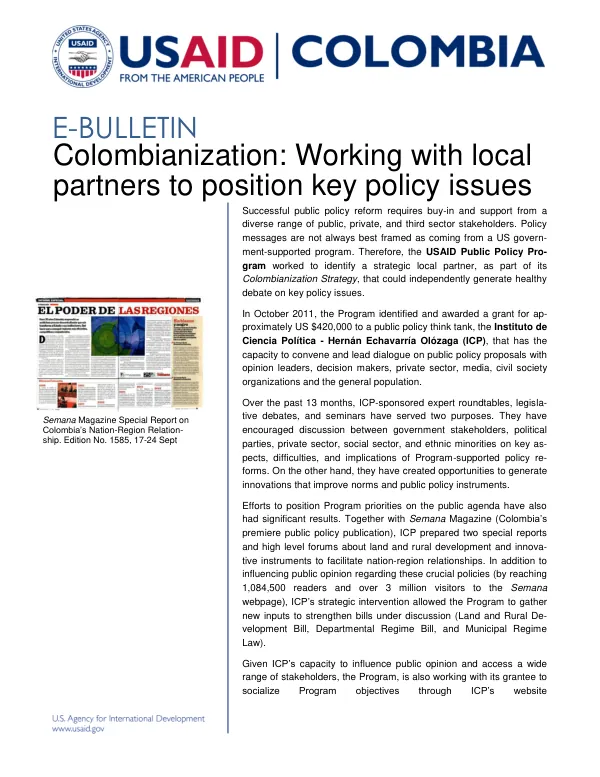
The program's goal is to achieve successful public policy reform by garnering support from a diverse range of stakeholders, including public, private, and third sector entities. To achieve this objective, the program worked to identify a strategic local partner that could independently generate debate on key policy issues. In October 2011, the program identified and awarded a grant to the Instituto de Ciencia Política - Hernán Echavarría Olózaga (ICP), a public policy think tank with the capacity to convene and lead dialogue on public policy proposals. Over the past 13 months, ICP-sponsored expert roundtables, legislative debates, and seminars have served two purposes. They have encouraged discussion between government stakeholders, political parties, private sector, social sector, and ethnic minorities on key aspects, difficulties, and implications of policy reforms. Additionally, these events have created opportunities to generate innovations that improve norms and public policy instruments. Efforts to position program priorities on the public agenda have yielded significant results. In collaboration with Semana Magazine, ICP prepared two special reports and high-level forums on land and rural development and innovative instruments to facilitate nation-region relationships. These initiatives have influenced public opinion regarding crucial policies, reaching 1,084,500 readers and over 3 million visitors to the Semana webpage. Furthermore, ICP's strategic intervention has allowed the program to gather new inputs to strengthen bills under discussion, including the Land and Rural Development Bill, Departmental Regime Bill, and Municipal Regime Law. The program is also working with ICP to socialize program objectives through ICP's website (www.icpcolombia.org). This will provide an additional channel of direct communication with a wide range of stakeholders, including opinion leaders, decision makers, private sector, media, civil society organizations, and the general population. By leveraging ICP's capacity to influence public opinion and access a diverse range of stakeholders, the program aims to achieve its objectives and contribute to successful public policy reform in Colombia. The Colombianization strategy has been instrumental in positioning key policy issues on the public agenda and generating debate on crucial reforms. By working with a strategic local partner, the program has been able to gather new inputs, influence public opinion, and strengthen bills under discussion. As the program continues to work with ICP, it is likely to achieve its objectives and contribute to successful public policy reform in Colombia.
Related documents