USAID DEC
Paramos & Forests Activity: Communities Set Historic Record-Forest Conservation Generates USO for Local Families
Sign inFONDO ACCIÓN
Paramos & Forests Activity: Communities Set Historic Record-Forest Conservation Generates USO for Local Families
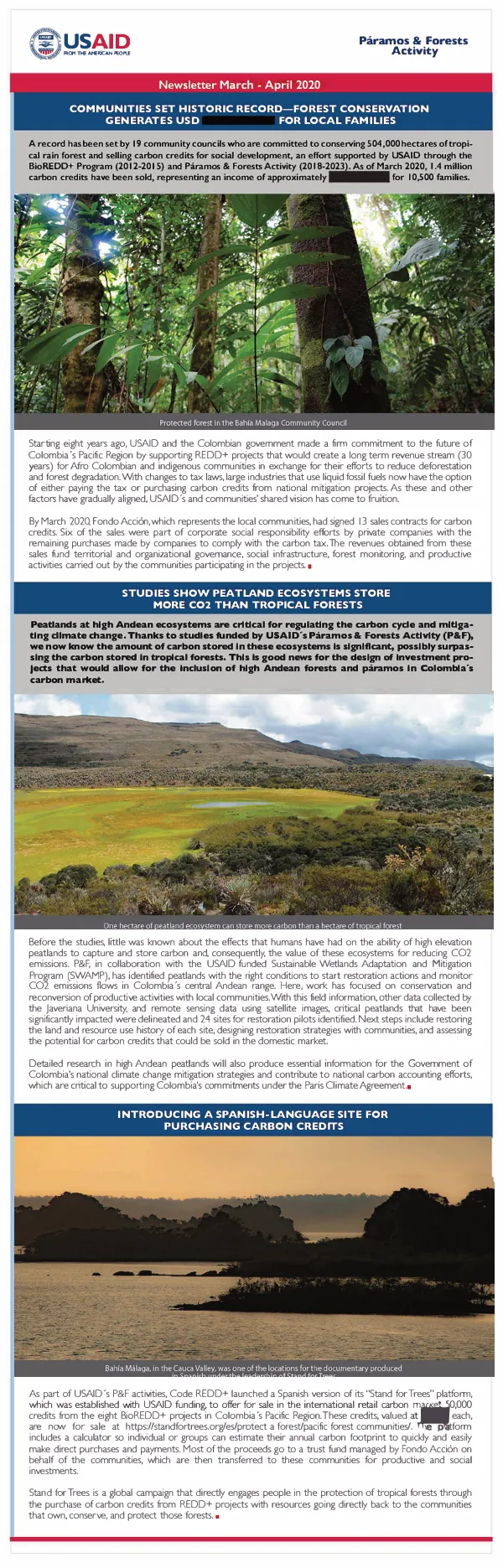
The Paramos & Forests Activity, supported by USAID, has made significant strides in forest conservation in Colombia's Pacific Region.
2020 · 1 pages
Sign in to readA free account is required to download.
Abstract
Nineteen community councils have committed to conserving 504,000 hectares of tropical rain forest and selling carbon credits for social development. As of March 2020, 1.4 million carbon credits have been sold, generating income for approximately 10,500 families. This effort is part of a larger commitment by USAID and the Colombian government to support REDD+ projects that create a long-term revenue stream for Afro-Colombian and indigenous communities in exchange for their efforts to reduce deforestation and forest degradation. The revenue generated from the sale of carbon credits funds various community activities, including territorial and organizational governance, social infrastructure, forest monitoring, and productive activities. Thirteen sales contracts have been signed by Fondo Accion, representing the local communities, with six sales being part of corporate social responsibility efforts by private companies and the remaining purchases made by companies to comply with the carbon tax. This revenue stream is expected to last for 30 years, providing a stable source of income for the communities. Studies funded by USAID's Paramos & Forests Activity have revealed that peatlands in high Andean ecosystems store more CO2 than tropical forests. This finding has significant implications for the design of investment projects that aim to include high Andean forests and paramos in Colombia's carbon market. The studies, conducted in collaboration with the USAID-funded Sustainable Wetlands Adaptation and Mitigation Program (SWAMP), have identified peatlands with the right conditions to start restoration actions and monitor CO2 emissions flows in Colombia's central Andean range. The research has focused on conservation and reconversion of productive activities with local communities, with 24 sites identified for restoration pilots. The next steps include restoring the land and resource use history of each site, designing restoration strategies with communities, and assessing the potential for carbon credits that could be sold in the domestic market. The findings from this research will also contribute to national climate change mitigation strategies and support Colombia's commitments under the Paris Climate Agreement. In addition to the conservation efforts, USAID's Paramos & Forests Activity has launched a Spanish-language site for purchasing carbon credits, called "Stand for Trees." The platform offers for sale carbon credits from eight BioREDD+ projects in Colombia's Pacific Region, with most of the proceeds going to a trust fund managed by Fondo Accion on behalf of the communities. The platform includes a calculator to help individuals estimate their annual carbon footprint and make direct purchases and payments. The proceeds from the sale of carbon credits will be transferred to the communities for productive and social investments.
Related documents
Documents in this collection
 2011
2011USAID DEC
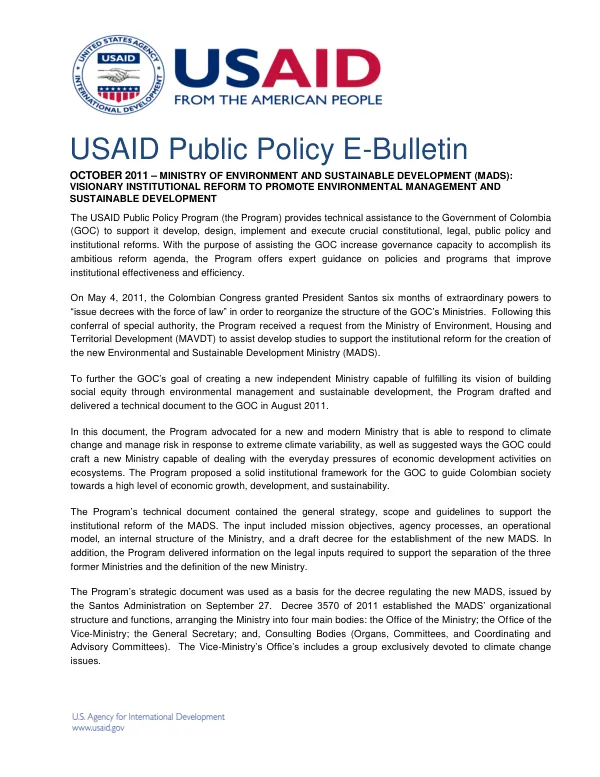
USAID Public Policy E-Bulletin: MINISTRY OF ENVIRONMENT AND SUSTAINABLE DEVELOPMENT (MADS): VISIONARY INSTITUTIONAL REFORM TO PROMOTE ENVIRONMENTAL MANAGEMENT AND SUSTAINABLE DEVELOPMENT
Open record 2020
2020USAID DEC