CHEMONICS
USAID Works Toward Having Post COVID-19 Resilient Communities and Ecosystems
The USAID Natural Wealth Program is working to establish post-COVID-19 resilient communities and ecosystems in Colombia.
2020 · 4 pages
Sign in to readA free account is required to download.
Abstract
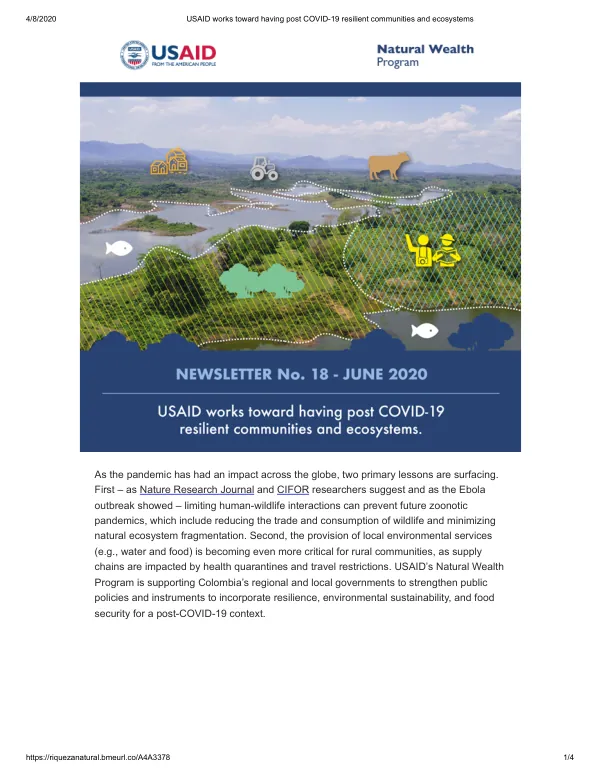
Two primary lessons have emerged from the pandemic: limiting human-wildlife interactions can prevent future zoonotic pandemics, and the provision of local environmental services is critical for rural communities. The program is supporting regional and local governments to strengthen public policies and instruments that incorporate resilience, environmental sustainability, and food security. To achieve this goal, the program has developed two initiatives to assist 34 municipalities, three departments, and five regional environmental authorities. The first initiative involves the creation of infographics that provide information on biodiversity richness, deforestation trends, water availability, mining and oil activities, and climate change scenarios. These infographics have been integrated into the 4-year development and action plans of 24 municipalities, three departments, and five regional environmental authorities, with a commitment to increase the protection of natural areas and adopt sustainable production practices. The second initiative focuses on identifying areas of key ecosystems and their connectivity corridors, which are essential for the provision of natural services. This information can be used to guide land use planning processes, prevent ecosystem fragmentation, and conserve key areas. The program has identified these ecosystem areas for five environmental authorities, which oversee 20 percent of the national territory. This approach can help maintain the region's livelihoods by identifying productive areas and preserving natural habitat for species, ultimately reducing the distance and level of interaction between humans and wildlife. The program has also updated the 2014 national-level map, using more and better information. For the department of La Guajira, the program identified greater areas of key ecosystems and connectivity corridors, which can prevent fragmentation of natural landscapes and maximize the provision of ecosystem services. The threats presented by the pandemic and aggravated by climate change impacts highlight the vulnerability of communities to be self-reliant and prevent future zoonotic diseases. Incorporating biodiversity conservation strategies in environmental land use and development plans can help communities address and adapt to future challenges. The Natural Wealth Program's initiatives aim to empower and transform governments and societies to become more resilient and independent in the face of future challenges. By supporting regional and local governments to develop policies and instruments that incorporate resilience, environmental sustainability, and food security, the program is working to establish post-COVID-19 resilient communities and ecosystems in Colombia.