USAID DEC
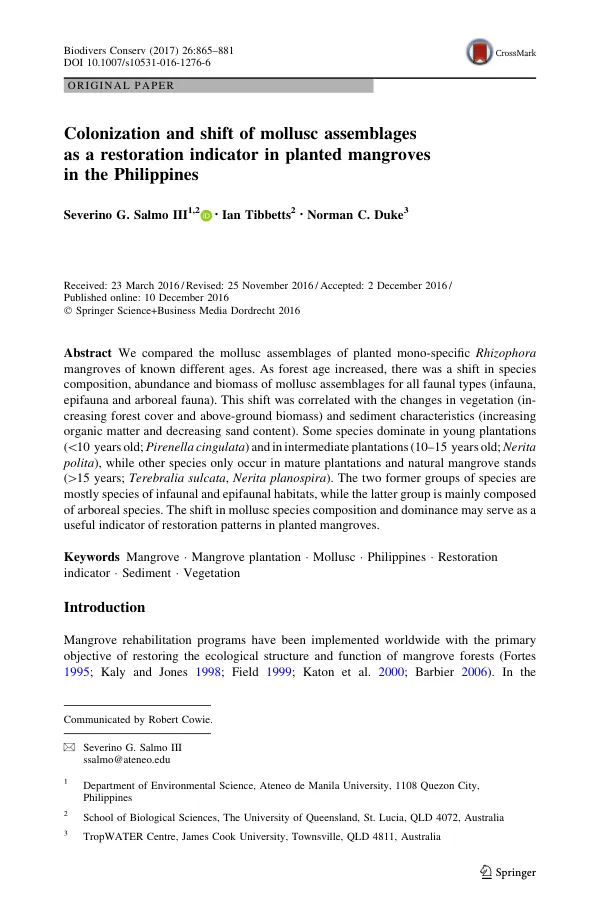
Colonization and shift of mollusc assemblages as a restoration indicator in planted mangroves in the Philippines
Sign inUSAID DEC
Colonization and shift of mollusc assemblages as a restoration indicator in planted mangroves in the Philippines
Mangrove rehabilitation programs have been implemented worldwide with the primary objective of restoring the ecological structure and function of mangrove forests.
2016 · 17 pages
Sign in to readA free account is required to download.
Abstract
In the Philippines, massive mangrove planting has been undertaken since the 1990s and is likely to continue as it becomes part of community rural development programs. Mangrove planting is a popular management tool that has long been practiced in the country, with most, if not all, of these planted mangroves being mono-specific with stunted growth and poor survival. Studies that evaluate mangrove rehabilitation programs have been rare and remain a challenge for researchers and resource managers. To date, only two guidelines have been developed that evaluate habitat functionality of planted mangroves. There is a need to understand how the development of forest structure and increased biomass is related to habitat function. While some studies estimate that it will take 20-25 years for planted mangroves to resemble the forest structure and productivity of natural mangroves and restore habitat functionality, empirical evidence to support such claims is lacking. Molluscs are one of the most conspicuous groups of the mangrove-dependent fauna, and they are often relatively sedentary in their adult stages. For these reasons, the changes in species composition of mollusc assemblages in different aged mangrove stands may serve as a useful proxy and indicator for the restoration of habitat functionality. The study set out to evaluate changes in mollusc assemblages in maturing mangrove stands with a view to quantifying any relationship between these changes and mangrove vegetation and sediment properties. The study sites were located in the Philippines, with planted mono-specific Rhizophora mangroves of different known ages. The sites were in Lingayen Gulf, Kalibo, and Bohol, and were dominated by R. mucronata, with some R. apiculata, R. stylosa, Avicennia marina, and Sonneratia alba. The average depth of tidal water across the study sites was estimated as 2 m during high tide, but forests are generally exposed at low tide. All sites receive precipitation of more than 1,700 mm year-1, with a Type I climate prevailing in Lingayen Gulf and Zambales, a Type II climate in Aklan, and a Type IV climate in Bohol. The study used a space-for-time approach to assess patterns in the trajectory of the restored system over time. This approach has been widely used in restoration ecology when optimal sampling design may not be possible. The study investigated the changes in mollusc assemblages in planted mangroves of different ages to assess patterns in the restoration trajectory and compared this trajectory with the patterns observed from mature and natural mangrove stands. Mollusc sampling was carried out in the same vegetation plots used in previous studies, with sampling done during low tide. Each plot was of 5 m radius, and three plots per stand were sampled. Molluscs were collected and measured from three faunal components within the mangrove forest: arboreal, epifaunal, and infaunal.
Related documents
Documents in this collection
 2019
2019USAID DEC
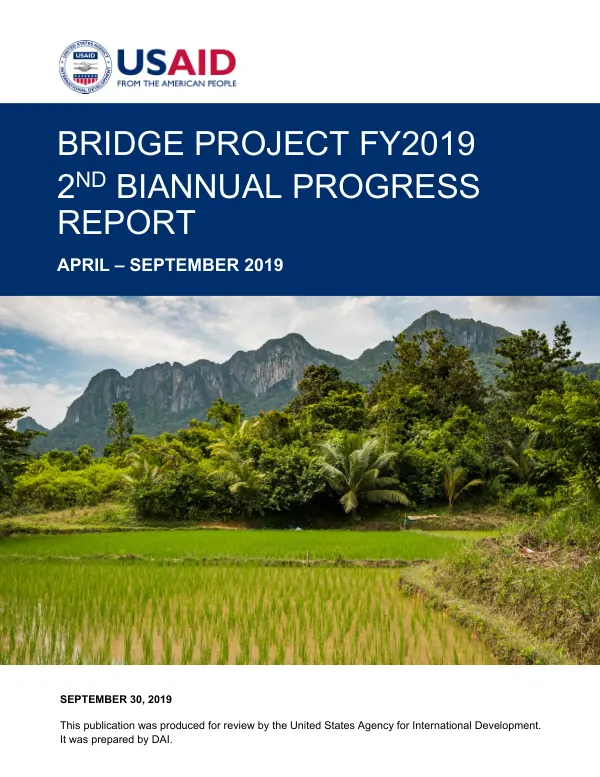
Biodiversity Results and Integrated Development Gains Enhanced (BRIDGE) Project FY2019 2nd BIANNUAL PROGRESS REPORT April – September 2019
Open record 2024
2024USAID DEC