USAID DEC
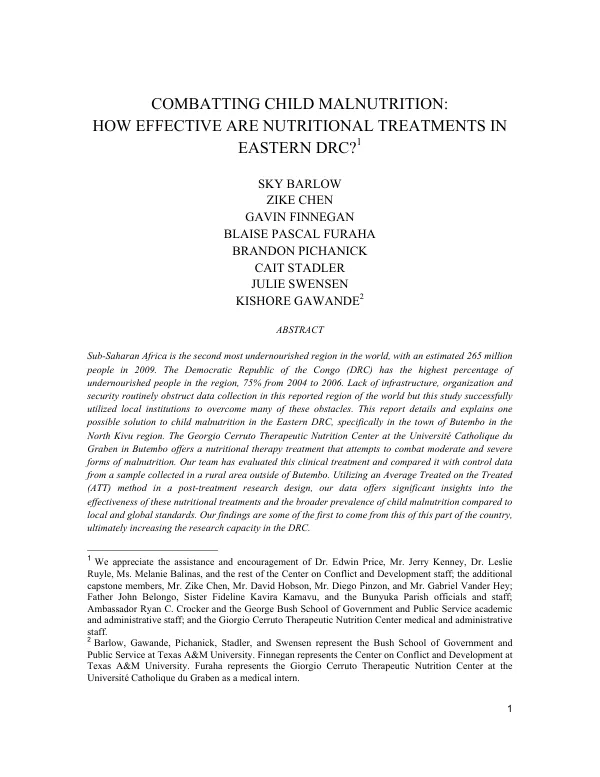
Combating Child Malnutrition: How Effective Are Nutritional Treatments in Eastern DRC?
Sign inTEXAS A&M INTERNATIONAL UNIVERSITY
Combating Child Malnutrition: How Effective Are Nutritional Treatments in Eastern DRC?
The Democratic Republic of the Congo (DRC) is located in Central Africa and is the second largest country on the continent after Algeria.
2014 · 28 pages
Sign in to readA free account is required to download.
Abstract
The DRC is a landlocked country with a tropical climate and is endowed with natural resources, including copper, cobalt, gold, and diamonds. However, the country has continued to have a weak economy and one of the lowest Human Development Index (HDI) rankings in the world. The DRC has experienced decades of fighting in the North Kivu region, which has led to poor performance in areas of health, education, and living standards. Malnutrition is a significant problem in the DRC, with an estimated 75% of the population being undernourished from 2004 to 2006. The Global Hunger Index (GHI) score for the DRC increased by 53% from 1990 to 2009, indicating a strong correlation with national instability. The average Congolese woman has 4.8 children, and the maternal mortality rate is 540 deaths for every 100,000 live births. The DRC ranks twelfth in the world in terms of infant mortality, with 73.15 deaths per 1,000 live births. The Giorgio Cerruto Therapeutic Nutrition Center at the Université Catholique du Graben in Butembo offers a nutritional therapy treatment that attempts to combat moderate and severe forms of malnutrition. The clinic's treatment has been evaluated using the Average Treated on the Treated (ATT) method in a post-treatment research design. The study aimed to answer two main questions: 1) What is the prevalence of child malnutrition in the Bunyuka Parish? and 2) Does clinical treatment positively affect the nutritional status of children? The research was conducted in two locations: the Giorgio Cerruto Therapeutic Nutrition Center in Butembo and the Bunyuka Parish, a smaller community located twelve kilometers outside of Butembo. The Bunyuka Parish is a rural community with limited access to basic services, including water and electricity. The community has two small clinics and a few generators that supply power to a small number of residents. The residents of Bunyuka do not speak French, which is the primary language spoken in Butembo. The study used anthropometric measures to assess child growth, weight, and Body Mass Index (BMI). The researchers collected data on the prevalence of child malnutrition in the Bunyuka Parish and evaluated the effectiveness of the clinic's treatment in reducing malnutrition. The study found that the prevalence of child malnutrition in the Bunyuka Parish was high, with 69% of children under the age of five being malnourished. The study also found that the clinic's treatment was effective in reducing malnutrition, with a significant improvement in the nutritional status of children who received treatment.
Related documents
Documents in this collection
 2020
2020USAID DEC
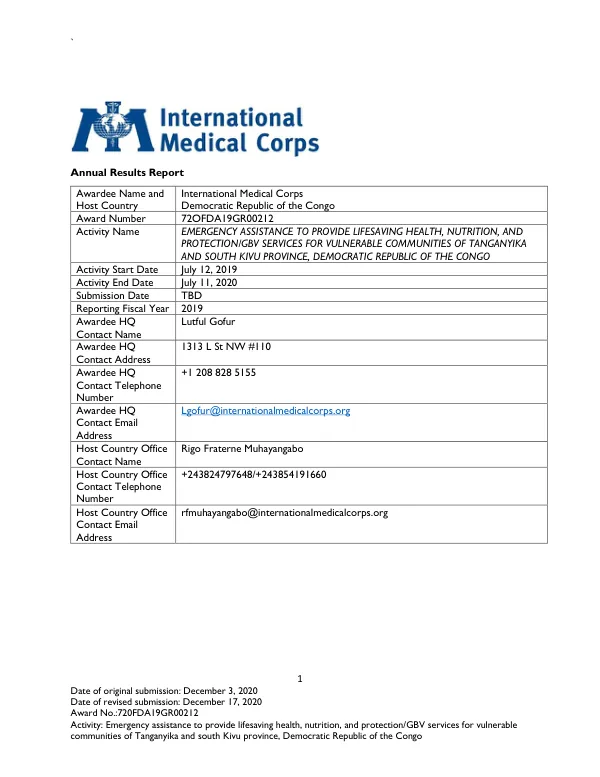
Annual Results Report: Emergency Assistance to Provide Lifesaving Health, Nutrition, and Protection/GBV Services for Vulnerable Communities of Tanganyika and South Kivu Province, Democratic Republic of the Congo
Open record 2020
2020USAID DEC