CDC
Combating Infectious Diseases: Fact Sheet
Combating Infectious Diseases is a critical global health issue.
2017 · 2 pages
Sign in to readA free account is required to download.
Abstract
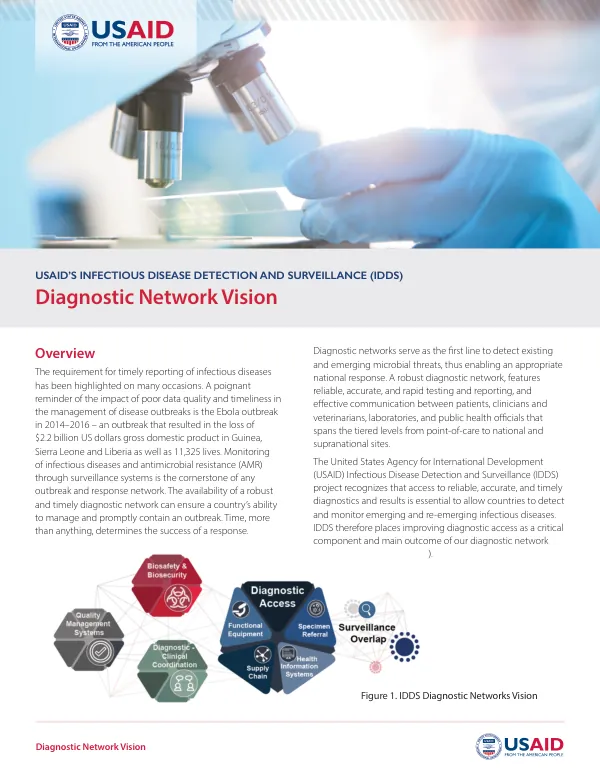
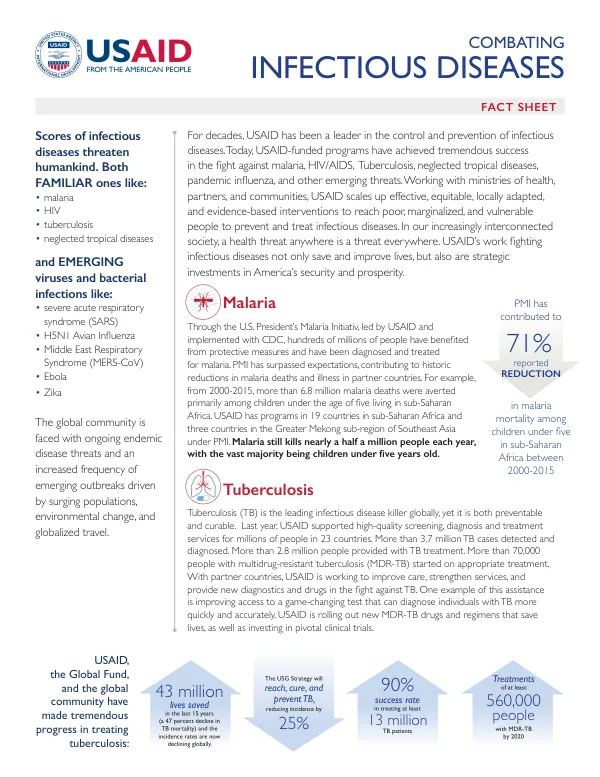
Infectious diseases such as malaria, HIV, tuberculosis, and emerging viruses and bacterial infections pose a significant threat to global health. These diseases are often prevalent in low-income countries with limited access to healthcare services. The U.S. Agency for International Development (USAID) has been a leader in the prevention and treatment of infectious diseases. Through the U.S. President's Malaria Initiative (PMI), USAID has provided protective measures and treatment to hundreds of millions of people, resulting in significant reductions in malaria deaths and illness. For example, between 2000 and 2015, more than 6.8 million malaria deaths were averted primarily among children under the age of five living in sub-Saharan Africa. Tuberculosis (TB) is the leading infectious disease killer globally, yet it is preventable and curable. USAID has supported high-quality screening, diagnosis, and treatment services for millions of people in 23 countries. In 2019, USAID supported the diagnosis and treatment of over 3.7 million TB cases, with over 2.8 million people provided with TB treatment. USAID is also working to improve care, strengthen services, and provide new diagnostics and drugs in the fight against TB. Neglected Tropical Diseases (NTDs) are a group of parasitic and bacterial infections that impact the poorest communities worldwide. USAID has supported the delivery of over 2 billion treatments to prevent and treat the seven most prevalent NTDs, benefiting over 935 million people across 25 countries. NTDs cause profound suffering and disability, perpetuating the cycle of poverty and inequality. USAID is also working to strengthen capacity in countries to prevent, detect, and respond to infectious diseases in animals and people through a One Health Approach. This approach focuses on hotspots of previous disease emergence and zones where the risks of spillover, amplification, and spread are greatest. Recent estimates indicate that only one percent of microbial threats have been identified, highlighting the need for continued vigilance and preparedness. The Global Health Security Agenda (GHSA) promotes global health security by supporting capacity building activities at the national level. These activities include improving laboratory systems, strengthening disease surveillance, improving biosafety and biosecurity, expanding workforce development, and improving emergency management. These efforts aim to prevent, detect, and respond to infectious diseases, reducing the risk of pandemics and protecting global health security. The cost-effectiveness of USAID's efforts is evident in the value of donated medicines for mass treatment campaigns. For every dollar invested by the US Government, $26 in donated medicines are leveraged, totaling $11 billion in value. This has resulted in nearly 200 million people no longer needing treatment for lymphatic filariasis (LF) and nearly 85 million people no longer needing treatment for blinding trachoma. The prevention and treatment of infectious diseases are critical to global health security. USAID's efforts have contributed to significant reductions in malaria deaths and illness, improved TB treatment outcomes, and reduced the burden of NTDs. The continued support of these efforts is crucial to preventing and responding to infectious disease outbreaks, protecting global health security, and promoting global health security.