USAID DEC
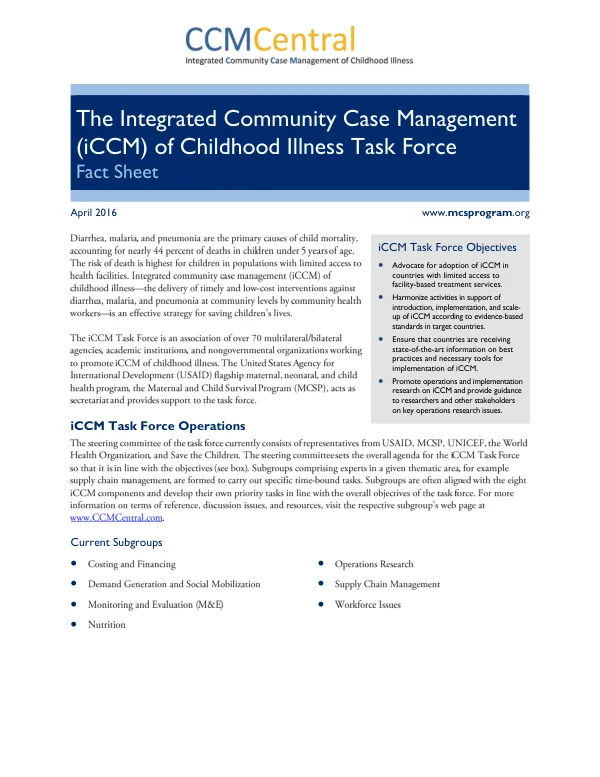
Integrated Community Case Management (iCCM) of Childhood Illness Task Force Fact Sheet
Sign inSAVE THE CHILDREN FUND
Integrated Community Case Management (iCCM) of Childhood Illness Task Force Fact Sheet
Diarrhea, malaria, and pneumonia are the primary causes of child mortality, accounting for nearly 44 percent of deaths in children under five years of age.
2013 · 2 pages
Sign in to readA free account is required to download.
Abstract
The risk of death is highest for children in populations with limited access to health facilities. Integrated community case management (iCCM) of childhood illness is an effective strategy for saving children's lives. iCCM involves the delivery of timely and low-cost interventions against diarrhea, malaria, and pneumonia at community levels by Community Health Workers (CHWs). The iCCM Task Force is an association of multilateral and bilateral agencies and non-governmental organizations working to promote integrated community level management of childhood illness. The USAID flagship maternal, neonatal, and child health program, the Maternal and Child Health Integrated Program (MCHIP), provides secretariat support to the Task Force. A steering committee sets the overall agenda for the iCCM Task Force, ensuring it aligns with the objectives. The steering committee consists of USAID, UNICEF, WHO, Save the Children, and MCHIP. Subgroups comprising experts in specific thematic areas, such as supply chain management, are formed to carry out specific tasks. These subgroups are often aligned with the eight iCCM benchmarks and develop their own priority tasks in line with the overall objectives of the Task Force. Current subgroups include supply chain management, monitoring and evaluation, operations research, and costing and financing. The iCCM Task Force has several objectives, including advocating for the adoption of iCCM in countries with limited access to facility-based treatment services, harmonizing activities in support of the introduction, implementation, and scale-up of iCCM, ensuring countries receive state-of-the-art information on best practices and necessary tools for implementation, and promoting operations and implementation research on iCCM. Key Task Force achievements include the development of the CCM Benchmark Framework, a tool for program planners and managers to design and implement CCM programs. The CCM Benchmark Framework is a comprehensive tool that spans various components, including coordination, policy setting, human resources, supervision, and quality assurance. The framework helps planners and implementers chart their way towards implementing a comprehensive CCM program at scale. The Task Force has also developed the CCM Indicators, a compendium of nine global indicators and a menu of 43 indicators that countries can choose from to monitor national iCCM programs. The CCM Indicators complement the CCM benchmarks by providing a harmonized set of metrics to measure CCM implementation and results.