ECODIT, INC.
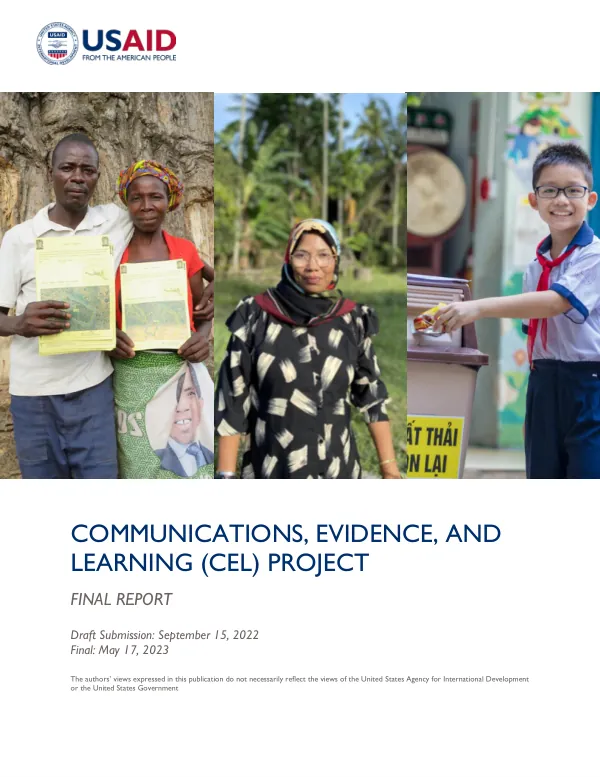
Communications, Evidence, and Learning (CEL) Project Final Report
The Communications, Evidence, and Learning (CEL) project was a five-year General Services Administration (GSA) Multiple Award Schedule contract implemented from May 2018 through May 2022 by a consortium led by Training Resources Group (TRG) with its partners NORC, Landesa, Urban Institute, Forum One, and ECODIT.
2023 · 53 pages
Sign in to readA free account is required to download.
Abstract
The project was designed to guide program design and implementation, inform policy discussions, and improve decision making to maximize the effectiveness of resources of USAID operating units (OUs) and field Missions in the areas of land tenure, property rights and resource governance; urban development, urban-based programming, and sustainable urbanization; and locally led, sustainable development. CEL was structured to provide technical assistance through the generation of evidence, the production of evidence-based communication, and the application of evidence and knowledge in learning products and processes. The project applied the evidence-CKM-learning model successfully to support a variety of USAID OUs and field Missions, helping them improve their knowledge and technical work, manage change, and continue to grow and achieve their development objectives. These included USAID's Land and Urban Office, Office of Local Sustainability, Gender Equality and Women's Empowerment, Global Climate Change, and Green Cities, as well as Missions in all regions. CEL produced a robust body of evidence and learnings, developed and disseminated a wide range of evidence-based communications and knowledge management (CKM) products, and built capacity of USAID OUs and field staff. The project team produced more than a dozen research publications and products, including impact evaluations and assessments, data collection and data analysis, and focused studies on topics such as land rights for credit access, conducting randomized control trials, and solid waste management/plastic pollution prevention. These knowledge generation activities contributed to a stronger and deeper evidence base in each portfolio and continue to facilitate a wide range of development objectives across Missions. CEL also focused on learning and building capacity of USAID Mission and DC-based staff and teams. This included one-on-one coaching, group trainings, and facilitation of workshops, webinars, and other events. Over time CEL increased the number of training and organizational development/facilitation events delivered in response to requests from OUs. By August 31, 2022, the project team had provided 171 unique events (76 training, 95 facilitation) with 934 unique individuals participating in training events and 1,502 in facilitation events. In addition, CEL developed new evidence-based programming guidance to inform the Agency's cross-sectoral programming related to democratic decentralization, urban resilience, and short-lived climate pollutants. CEL made continuous contributions to facilitating and strengthening collaboration, coordination, and communication, including assistance to Missions to apply evidence, support for peer learning, and facilitation of inter-Agency collaboration on new programming in air pollution and urban resilience. CEL also enhanced integration of the Agency's work on environmental and natural resource management and helped to increase USAID's engagement on land and urban work challenges with implementers partners and other stakeholders. An important focus of CEL's technical assistance was strengthening USAID's vital work on gender equality and strengthening women's empowerment. CEL supported research, communications, and learning that addressed gender across all of the technical portfolios. This included expansion of the evidence base for women's land rights through differential analyses of female-headed households, male-headed households, and wives and gender-specific issues, as well as research and development of CKM products highlighting specific areas of the cross section between gender and women's empowerment and work in urban areas. Lessons learned from the CEL project include the importance of having a clear USAID point of contact engaging throughout the process who has authority to synthesize input and make decisions. Activities and products are most likely to be valued and used when the audience and objectives are clearly defined at the outset and are created to answer an immediate need or interest of the audience. Identifying shared objectives, roles and responsibilities, and decision-making authority and process when collaborating on activities or products with multiple contracts, Agency teams, or Inter-Agency staff is also crucial.
Related documents