ECODIT, INC.
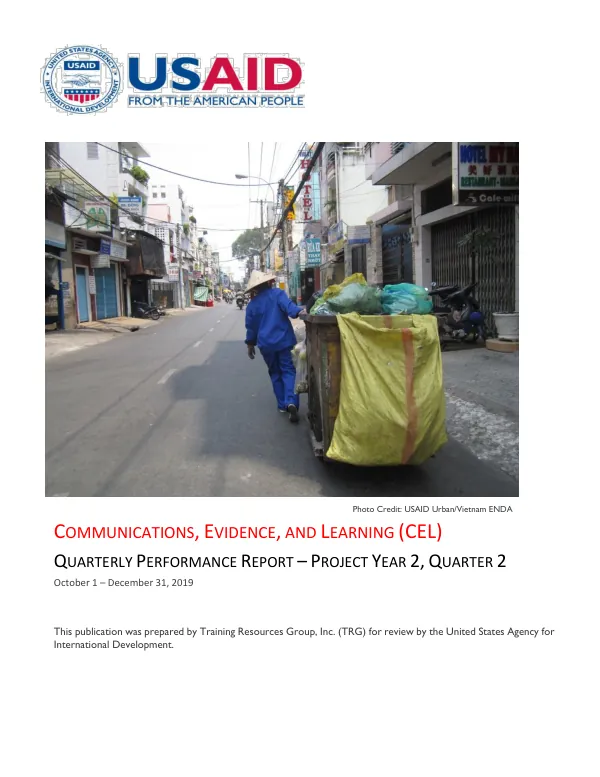
CEL Quarterly Performance Report 2: Oct - Dec 2018
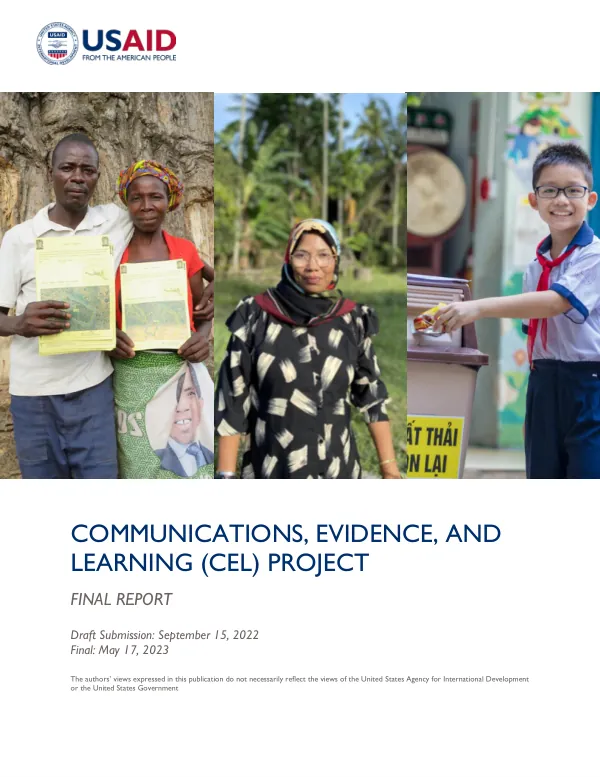
The United States Agency for International Development (USAID) has contracted with the Training Resources Group (TRG) as the implementing partner for the Communications, Evidence, and Learning (CEL) project.
2018 · 25 pages
Sign in to readA free account is required to download.
Abstract
The CEL project is a five-year contract with a three-year base period and two option years, effective from May 23, 2018, to May 20, 2023. TRG will implement CEL with its partners, including NORC, Landesa, Urban Institute, and Forum. The CEL project provides USAID's Bureau for Economic Growth, Education, and Learning (E3) and the Land and Urban Office (LU) with an integrated approach across three primary functions: knowledge generation, knowledge dissemination, and knowledge application. The project aims to build upon and expand the body of evidence-based knowledge through rigorous impact and performance evaluations, research, and analysis, and targeted pilot projects in selected countries. CEL's approach is guided by key principles and concepts that emphasize the importance of communicating and building capacity among various stakeholders, including USAID Missions, bureaus, and operating units, U.S. Government (USG) partners, other donors, local implementers, implementing partners, host country governments, and civil society. The project views knowledge generation, dissemination, and application as an integrated process, where each element informs and influences the others. During the reporting period from October 1 to December 31, 2018, CEL advanced key activities in the Work Plan for knowledge generation, dissemination, and dissemination. Highlights of the work include: Knowledge Generation Activities: * Impact Evaluation for the Deforestation Free Cocoa in Ghana evaluation * Land tenure country profiles * Brief on land tenure and women's empowerment * Research development for Land and Urban * Urban Project Inventory * Yearly thematic analysis of Performance and Reports (PPR) key issue narratives Knowledge Dissemination Activities: * Land reach products: blogs, Flickr, country timelines * Land and Urban content, LandLinks redesign * Communications technical assistance for Our Oceans and A conferences, and Urban Visioning Workshop * UrbanLinks redesign Knowledge Application Activities: * Learning Needs Assessments for Land and Urban * Urban Visioning Workshop/Private-Sector co-meeting * Local Sustainability training The Land Team/LU Office implemented Task 1 Evaluations, which involve impact and performance evaluation activities to measure project effectiveness, efficiency, and efficiency, and generate systematic and rigorous evidence and knowledge to inform future program planning. The task includes weekly joint task calls for task coordination and evaluation. The Work Assignments section outlines the tasks and activities implemented by each office, including the Land Team/LU Office, Urban Team/LU Office, and Office of Local Sustainability. The Issues and Challenges section highlights the challenges and issues encountered during the reporting period, including the need for more effective communication and collaboration among stakeholders. The Project Management section outlines the project's management structure, personnel, and processes, including the use of management systems and learning systems to track progress and identify areas for improvement. The Finance and Administration section outlines the project's financial management, including the use of budgeting and accounting systems to track expenses and track expenses. The Next Quarter Task Activity section outlines the tasks and activities planned for the next quarter, including the implementation of new projects and the continuation of ongoing activities. The report concludes with an annex section that includes additional information on the project's progress, including the LandLinks content, Land and Urban baseline indicators, and the UrbanLinks content.
Related documents